Video Projectors Explained
Ever wondered what actually happens inside a video projector? We trace the technology from 1940s Eidophor systems and NASA mission control displays through CRT, LCD, DLP, laser diode, and today's spectacular triple laser projectors.
Ian Gardner is a British-American broadcaster, voice artist and audio enthusiast, sharing years of experience building creative workflows from a modern home studio. He helps readers make smarter buying decisions across studio gear, production tools and home comforts for both inside and outside the workspace. Broadcasters, podcasters, voice artists, producers and digital creators will find guidance that supports high production values and efficient workflows for building a successful home studio business. Similar articles can be found in the televisions blog.
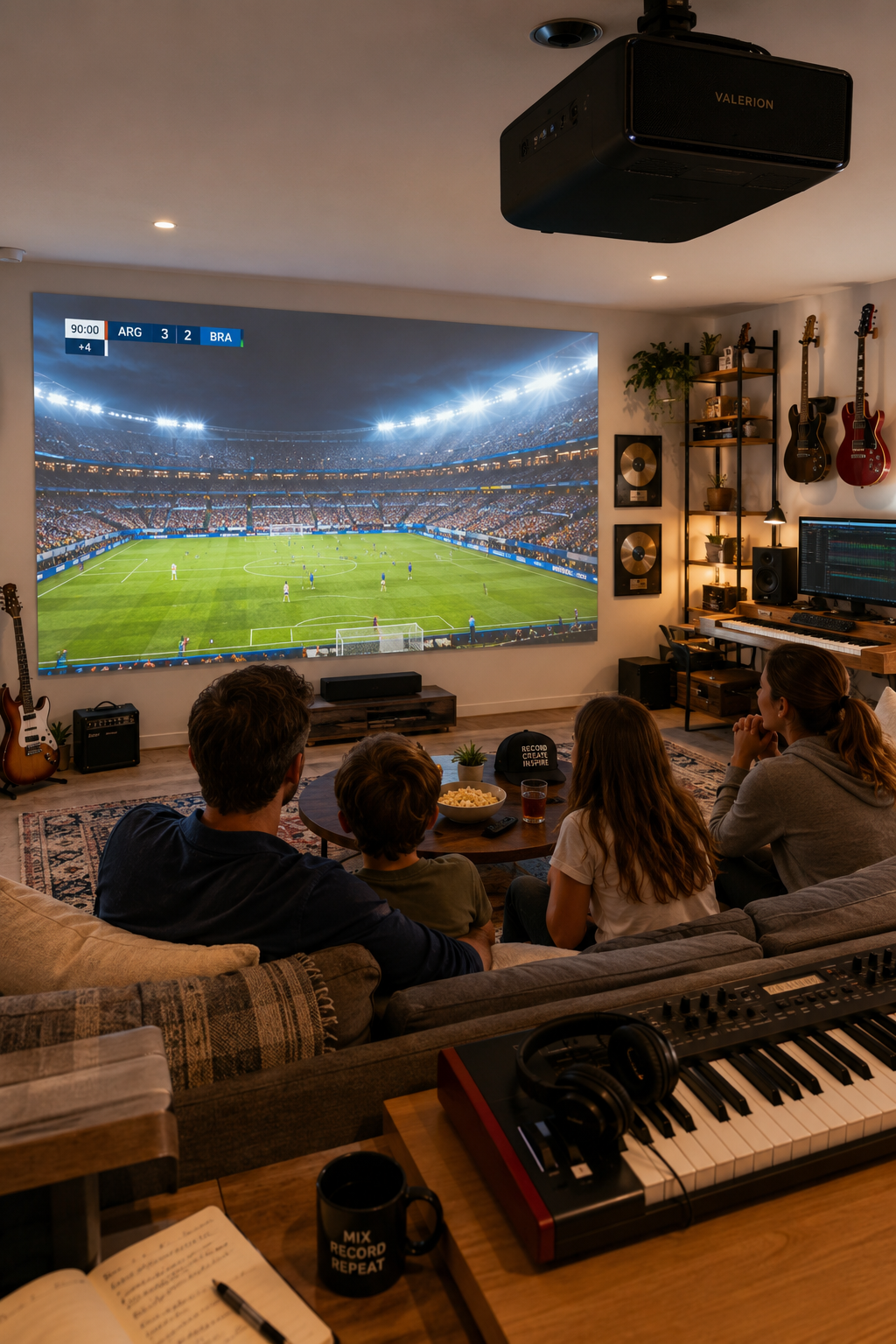
Imagine trying to make a cinema-sized image in your home studio using technology from the 1940s. You would not be mounting a sleek 4K laser projector to the ceiling. You would be wheeling in something closer to a scientific experiment that looked ready to power a small submarine. Welcome to the strange, brilliant history of video projectors.
The story begins with the Eidophor projector, developed in the 1940s by Swiss physicist Fritz Fischer. The Eidophor was one of the first serious attempts to project live television images onto enormous screens. It worked using an analog video signal and a surprisingly theatrical optical system. Instead of tiny digital mirrors or LCD panels, the Eidophor used a thin layer of oil spread across a rotating disc. An electron beam modulated the oil surface according to the incoming video signal, creating microscopic ripples. Light reflected from this disturbed oil surface was then manipulated through optics to create a projected image. Yes, your modern projector owes something to vibrating oil.
Eidophor systems were huge, expensive, hot, and gloriously overengineered, but they could generate theatre-sized images long before modern digital projection existed. NASA famously used Eidophor projectors in mission control rooms during the Apollo era because they could display large live video feeds to entire teams of engineers. If your home studio ever feels cluttered with a few microphones, acoustic panels, and cables, be grateful you are not trying to accommodate an Eidophor.
By the early 1950s, projector technology began borrowing heavily from television itself. The first colour CRT projectors emerged, using Cathode Ray Tube technology similar to televisions of the period. If you have already explored television history in my article about who invented TV and how television evolved, you will recognise some familiar concepts here.
CRT projectors typically used three separate picture tubes - red, green, and blue. Each tube generated its own monochrome image using an electron beam scanning phosphor-coated surfaces. Those three coloured images were then aligned and projected through lenses onto a screen. This process, known as convergence, was famously fiddly. Owning a CRT projector could sometimes feel like maintaining a vintage tape machine that also demanded an engineering degree.
Still, CRT projectors produced rich blacks, excellent colour depth, and genuinely impressive image quality for their era. They became popular in boardrooms, simulators, classrooms, and serious home theatre installations. The downside? Weight. Size. Heat. Complexity. You did not casually tuck a CRT projector onto a bookshelf beside your studio monitors.
As computing and display technology advanced through the 1980s and 1990s, LCD projectors began changing the game. LCD stands for Liquid Crystal Display, and the core idea is remarkably clever. Modern LCD projectors use tiny LCD panels as light gates. A powerful white light source shines through optical components that split the light into red, green, and blue channels. Each colour beam passes through its own LCD panel containing thousands or millions of liquid crystal pixels.
These liquid crystals twist and untwist under electrical control. When aligned one way, they allow light to pass. When aligned another way, they block it. By controlling light transmission pixel by pixel across the red, green, and blue channels, the projector creates a full colour image which is recombined and projected through the lens.
LCD projection brought brighter images, sharper detail, and smaller form factors. Suddenly, video projection became much more practical for offices, classrooms, and home enthusiasts. For studio owners editing music videos, scoring film cues, or simply wanting an absurdly oversized second monitor, projectors became increasingly tempting.
Around the same period, DLP projection arrived and introduced an entirely different engineering philosophy. DLP, or Digital Light Processing, was developed by Texas Instruments and uses a Digital Micromirror Device, essentially a semiconductor chip covered in microscopic mirrors. We are talking hundreds of thousands or millions of mirrors, each representing a single pixel.
Each mirror tilts rapidly toward or away from the projection lens. When tilted toward the lens, light reaches the screen. When tilted away, it does not. Colour is created either using spinning colour wheels or, in more advanced designs, separate colour light sources. DLP systems became known for smooth motion, excellent sharpness, and reliable operation.
If LCD projection is like carefully controlling light through adjustable blinds, DLP projection is more like commanding an army of microscopic robotic mirrors at impossible speed. It is delightfully nerdy technology.
Then came LED and laser diode based projection systems. Smaller projectors began using LEDs and laser diodes as light sources rather than traditional lamps. Conventional projector lamps wear out, generate heat, and eventually demand replacement. Laser diodes changed that equation. They offered longer lifespans, faster startup times, improved efficiency, and more consistent colour performance.
Laser diode systems opened the door to compact projectors, portable units, and increasingly capable home cinema machines. Some systems combined LEDs with laser illumination. Others pushed toward pure laser architectures.
Modern laser projectors take this concept much further. Rather than simply replacing the lamp, they often use dedicated laser light sources for primary colours. In RGB laser systems, separate red, green, and blue lasers provide exceptionally wide colour gamut coverage and strong brightness performance. Some systems still pair laser illumination with DLP imaging chips, but the light source itself becomes dramatically more advanced.
Today, projector technology competes not only with televisions but also with giant direct-view displays. If you are curious about those massive modular screens appearing in broadcast studios, stadiums, and live events, my article explaining what an LED video wall is and how it works connects nicely with this part of the story. Yet projectors still hold a unique advantage - they can create enormous cinematic images without requiring a wall made entirely of LEDs.
That brings us to the latest generation of projection technology and products like the Valerion VisionMaster Pro2 Triple Laser Projector. This is a long way from vibrating oil and Apollo mission rooms. The VisionMaster Pro2 uses an RGB triple laser light source paired with advanced DLP imaging to produce 4K UHD projection with extremely wide colour reproduction. It supports Dolby Vision, HDR formats, high refresh gaming features, low input lag, and broad colour gamut performance aimed at serious home cinema enthusiasts and gamers alike. Triple laser architecture means dedicated red, green, and blue laser sources generate cleaner, more saturated colour without relying on colour wheels or conventional lamps. In practical terms, that means brighter highlights, punchier colour, stronger contrast, and an image that feels remarkably alive. For a modern home studio setup, whether you are editing visuals, screening content, gaming after a long mix session, or simply turning a spare wall into a private cinema, the Valerion VisionMaster Pro2 demonstrates just how far projector technology has travelled since the days when NASA engineers gathered around giant oil-based projection systems.
The story begins with the Eidophor projector, developed in the 1940s by Swiss physicist Fritz Fischer. The Eidophor was one of the first serious attempts to project live television images onto enormous screens. It worked using an analog video signal and a surprisingly theatrical optical system. Instead of tiny digital mirrors or LCD panels, the Eidophor used a thin layer of oil spread across a rotating disc. An electron beam modulated the oil surface according to the incoming video signal, creating microscopic ripples. Light reflected from this disturbed oil surface was then manipulated through optics to create a projected image. Yes, your modern projector owes something to vibrating oil.
Eidophor systems were huge, expensive, hot, and gloriously overengineered, but they could generate theatre-sized images long before modern digital projection existed. NASA famously used Eidophor projectors in mission control rooms during the Apollo era because they could display large live video feeds to entire teams of engineers. If your home studio ever feels cluttered with a few microphones, acoustic panels, and cables, be grateful you are not trying to accommodate an Eidophor.
By the early 1950s, projector technology began borrowing heavily from television itself. The first colour CRT projectors emerged, using Cathode Ray Tube technology similar to televisions of the period. If you have already explored television history in my article about who invented TV and how television evolved, you will recognise some familiar concepts here.
CRT projectors typically used three separate picture tubes - red, green, and blue. Each tube generated its own monochrome image using an electron beam scanning phosphor-coated surfaces. Those three coloured images were then aligned and projected through lenses onto a screen. This process, known as convergence, was famously fiddly. Owning a CRT projector could sometimes feel like maintaining a vintage tape machine that also demanded an engineering degree.
Still, CRT projectors produced rich blacks, excellent colour depth, and genuinely impressive image quality for their era. They became popular in boardrooms, simulators, classrooms, and serious home theatre installations. The downside? Weight. Size. Heat. Complexity. You did not casually tuck a CRT projector onto a bookshelf beside your studio monitors.
As computing and display technology advanced through the 1980s and 1990s, LCD projectors began changing the game. LCD stands for Liquid Crystal Display, and the core idea is remarkably clever. Modern LCD projectors use tiny LCD panels as light gates. A powerful white light source shines through optical components that split the light into red, green, and blue channels. Each colour beam passes through its own LCD panel containing thousands or millions of liquid crystal pixels.
These liquid crystals twist and untwist under electrical control. When aligned one way, they allow light to pass. When aligned another way, they block it. By controlling light transmission pixel by pixel across the red, green, and blue channels, the projector creates a full colour image which is recombined and projected through the lens.
LCD projection brought brighter images, sharper detail, and smaller form factors. Suddenly, video projection became much more practical for offices, classrooms, and home enthusiasts. For studio owners editing music videos, scoring film cues, or simply wanting an absurdly oversized second monitor, projectors became increasingly tempting.
Around the same period, DLP projection arrived and introduced an entirely different engineering philosophy. DLP, or Digital Light Processing, was developed by Texas Instruments and uses a Digital Micromirror Device, essentially a semiconductor chip covered in microscopic mirrors. We are talking hundreds of thousands or millions of mirrors, each representing a single pixel.
Each mirror tilts rapidly toward or away from the projection lens. When tilted toward the lens, light reaches the screen. When tilted away, it does not. Colour is created either using spinning colour wheels or, in more advanced designs, separate colour light sources. DLP systems became known for smooth motion, excellent sharpness, and reliable operation.
If LCD projection is like carefully controlling light through adjustable blinds, DLP projection is more like commanding an army of microscopic robotic mirrors at impossible speed. It is delightfully nerdy technology.
Then came LED and laser diode based projection systems. Smaller projectors began using LEDs and laser diodes as light sources rather than traditional lamps. Conventional projector lamps wear out, generate heat, and eventually demand replacement. Laser diodes changed that equation. They offered longer lifespans, faster startup times, improved efficiency, and more consistent colour performance.
Laser diode systems opened the door to compact projectors, portable units, and increasingly capable home cinema machines. Some systems combined LEDs with laser illumination. Others pushed toward pure laser architectures.
Modern laser projectors take this concept much further. Rather than simply replacing the lamp, they often use dedicated laser light sources for primary colours. In RGB laser systems, separate red, green, and blue lasers provide exceptionally wide colour gamut coverage and strong brightness performance. Some systems still pair laser illumination with DLP imaging chips, but the light source itself becomes dramatically more advanced.
Today, projector technology competes not only with televisions but also with giant direct-view displays. If you are curious about those massive modular screens appearing in broadcast studios, stadiums, and live events, my article explaining what an LED video wall is and how it works connects nicely with this part of the story. Yet projectors still hold a unique advantage - they can create enormous cinematic images without requiring a wall made entirely of LEDs.
That brings us to the latest generation of projection technology and products like the Valerion VisionMaster Pro2 Triple Laser Projector. This is a long way from vibrating oil and Apollo mission rooms. The VisionMaster Pro2 uses an RGB triple laser light source paired with advanced DLP imaging to produce 4K UHD projection with extremely wide colour reproduction. It supports Dolby Vision, HDR formats, high refresh gaming features, low input lag, and broad colour gamut performance aimed at serious home cinema enthusiasts and gamers alike. Triple laser architecture means dedicated red, green, and blue laser sources generate cleaner, more saturated colour without relying on colour wheels or conventional lamps. In practical terms, that means brighter highlights, punchier colour, stronger contrast, and an image that feels remarkably alive. For a modern home studio setup, whether you are editing visuals, screening content, gaming after a long mix session, or simply turning a spare wall into a private cinema, the Valerion VisionMaster Pro2 demonstrates just how far projector technology has travelled since the days when NASA engineers gathered around giant oil-based projection systems.
You may purchase items mentioned in this article here. Affiliate links earn me a commission at no extra cost to you. Thanks for supporting IanGardner.com