Sony BRAVIA 8 II 65" QD OLED 4K TV Review
A serious investment for picture lovers, this Sony flagship combines stunning OLED blacks, vivid QD OLED color, smooth 120Hz motion and powerful AI processing.
Ian Gardner is a British-American broadcaster, voice artist and audio enthusiast, sharing years of experience building creative workflows from a modern home studio. He helps readers make smarter buying decisions across studio gear, production tools and home comforts for both inside and outside the workspace. Broadcasters, podcasters, voice artists, producers and digital creators will find guidance that supports high production values and efficient workflows for building a successful home studio business. Similar articles can be found in the televisions blog.
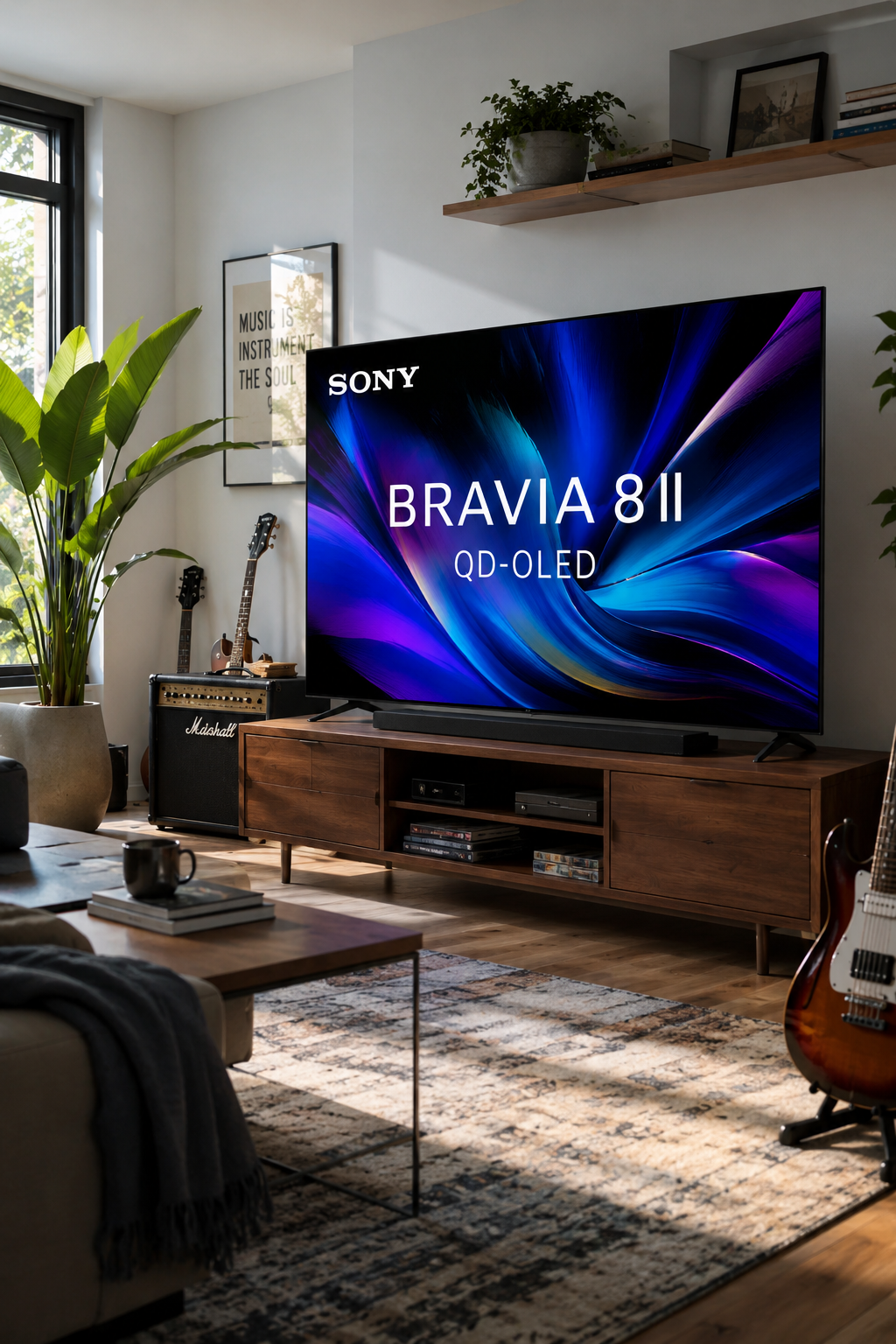
If you work in a home studio, you already know the danger of 'just checking something on YouTube'. One minute you're researching camera lighting techniques or browsing microphones you absolutely do not need. Ten minutes later you're watching a 4K aerial tour of Norway while quietly reassessing every display in your workspace. The Sony BRAVIA 8 II 65 Inch QD OLED TV has that effect. It doesn't simply show pictures - it makes lesser screens look like they owe you an apology.
At 65 inches, this is not a modest television trying to blend politely into the corner of your studio. Yet thanks to its ultra slim design, it manages to look sleek rather than overwhelming. It resembles a giant sheet of futuristic glass that wandered into your creative space and immediately started critiquing your lighting setup. Sony has clearly built this TV for viewers who obsess over picture quality, and that focus comes through in almost every specification.
The big talking point here is QD OLED technology. If TV terminology sometimes feels like somebody locked a marketing department inside a room with too many acronyms, you may enjoy my glossary of television jargon The Big Picture. In straightforward terms, QD OLED combines OLED's famous black levels with Quantum Dot color performance. The result is a display capable of stunning contrast, vivid color, and impressive brightness without sacrificing realism.
Sony highlights the fact that over 8 million self-lit pixels are precisely controlled to produce pure black with the highest OLED brightness, and in this case the claim is backed up by genuinely impressive performance. Each pixel produces its own light independently rather than relying on a traditional backlight system. That means dark scenes can look genuinely dark rather than slightly gray and vaguely disappointed. In a home studio environment where lighting conditions change from bright afternoon editing sessions to late night movie marathons, that contrast performance becomes more than just a bullet point on a spec sheet.
Picture quality is where the BRAVIA 8 II truly earns its premium status. Yes, the price tag is undeniably high. This is not the kind of purchase you casually add to your cart alongside a USB cable and a pack of guitar picks. But when you feed this television quality content, the payoff becomes obvious. Movies gain cinematic depth, streaming shows look richer and more dimensional, and HDR content gets the kind of visual punch that makes you stop scrolling and actually pay attention.
Colors are one of the standout strengths of this TV. The QD OLED panel delivers vibrant hues without falling into the trap of looking artificially oversaturated. Skin tones remain natural, landscapes appear rich and textured, and bright highlights have serious impact without washing out surrounding detail. Concert footage, sci-fi visuals, sunsets, neon cityscapes, dramatic lighting setups - everything gains extra realism and depth. For anyone working creatively in a home studio, that visual fidelity can be particularly satisfying.
Sony's XR Processor with AI Technology deserves plenty of credit for the polished image quality. The processor analyzes picture elements in real time and optimizes contrast, color, detail, and motion handling. Admittedly, 'AI Technology' gets attached to products with alarming enthusiasm these days, sometimes sounding about as meaningful as 'premium air infused freshness'. Sony's implementation, however, feels genuinely useful. The XR processing manages to enhance clarity and depth without making content look harsh, overly sharpened, or unnaturally processed.
One particularly impressive area is upscaling. Not everything you watch will be pristine native 4K footage captured by obsessive cinematographers using cameras worth more than your car. Older material, compressed streaming content, broadcast television, archived concerts, and random online videos all benefit from Sony's processing approach. The XR Processor works surprisingly hard to clean up imperfect sources and extract detail from material that probably wasn't expecting this level of scrutiny.
Motion performance is another major selling point. This is a 120Hz television, which means smoother handling of sports, gaming, fast action scenes, and rapid camera movement. If you've ever watched a fast football match dissolve into a blurry panic of motion artifacts on an average screen, you'll appreciate what higher refresh rates bring to the experience. In a home studio context, smoother playback can also be useful for reviewing edits, animation work, music videos, or motion-heavy creative projects.
The Smart Google TV platform rounds out the package with a modern connected experience. Streaming services, voice functionality, recommendations, and app integration are all built in. Whether you're bouncing between Netflix, YouTube tutorials, music documentaries, or suspiciously expensive 8K nature footage designed to justify your display purchase, navigation remains straightforward. And yes, the remote still matters. If you enjoy the strange and surprisingly dramatic history of television remotes, from ultrasonic clicks to infrared chaos, take a look at The Evolution of TV Remote Controls.
From a design perspective, the BRAVIA 8 II fits beautifully into a home studio setup. Creative spaces already tend to collect monitors, keyboards, interfaces, acoustic treatment, notebooks, cables, and coffee mugs with alarming efficiency. A bulky television can dominate the room in all the wrong ways. Sony's slim profile helps this TV feel premium and substantial without becoming visually intrusive. It looks expensive because, quite frankly, it is.
There are certainly cheaper televisions available. If your main requirement is simply 'plays TV shows and occasionally displays weather forecasts', many less expensive options will keep you perfectly happy. But if picture quality sits high on your priority list, the Sony BRAVIA 8 II makes a compelling case for its premium pricing. The deep blacks, excellent HDR brightness, vivid QD OLED color performance, intelligent XR processing, 120Hz smoothness, and refined industrial design combine into a genuinely luxurious viewing experience.
For home studio owners, this television occupies an interesting middle ground between entertainment centerpiece and creative inspiration. It is the kind of screen that makes demo reels look sharper, movies feel more immersive, and ordinary streaming content strangely difficult to switch off. The Sony BRAVIA 8 II asks a lot from your wallet, but it gives a lot back in return. Just don't blame the television when your planned five minute break quietly evolves into a three hour documentary marathon in glorious OLED black.
At 65 inches, this is not a modest television trying to blend politely into the corner of your studio. Yet thanks to its ultra slim design, it manages to look sleek rather than overwhelming. It resembles a giant sheet of futuristic glass that wandered into your creative space and immediately started critiquing your lighting setup. Sony has clearly built this TV for viewers who obsess over picture quality, and that focus comes through in almost every specification.
The big talking point here is QD OLED technology. If TV terminology sometimes feels like somebody locked a marketing department inside a room with too many acronyms, you may enjoy my glossary of television jargon The Big Picture. In straightforward terms, QD OLED combines OLED's famous black levels with Quantum Dot color performance. The result is a display capable of stunning contrast, vivid color, and impressive brightness without sacrificing realism.
Sony highlights the fact that over 8 million self-lit pixels are precisely controlled to produce pure black with the highest OLED brightness, and in this case the claim is backed up by genuinely impressive performance. Each pixel produces its own light independently rather than relying on a traditional backlight system. That means dark scenes can look genuinely dark rather than slightly gray and vaguely disappointed. In a home studio environment where lighting conditions change from bright afternoon editing sessions to late night movie marathons, that contrast performance becomes more than just a bullet point on a spec sheet.
Picture quality is where the BRAVIA 8 II truly earns its premium status. Yes, the price tag is undeniably high. This is not the kind of purchase you casually add to your cart alongside a USB cable and a pack of guitar picks. But when you feed this television quality content, the payoff becomes obvious. Movies gain cinematic depth, streaming shows look richer and more dimensional, and HDR content gets the kind of visual punch that makes you stop scrolling and actually pay attention.
Colors are one of the standout strengths of this TV. The QD OLED panel delivers vibrant hues without falling into the trap of looking artificially oversaturated. Skin tones remain natural, landscapes appear rich and textured, and bright highlights have serious impact without washing out surrounding detail. Concert footage, sci-fi visuals, sunsets, neon cityscapes, dramatic lighting setups - everything gains extra realism and depth. For anyone working creatively in a home studio, that visual fidelity can be particularly satisfying.
Sony's XR Processor with AI Technology deserves plenty of credit for the polished image quality. The processor analyzes picture elements in real time and optimizes contrast, color, detail, and motion handling. Admittedly, 'AI Technology' gets attached to products with alarming enthusiasm these days, sometimes sounding about as meaningful as 'premium air infused freshness'. Sony's implementation, however, feels genuinely useful. The XR processing manages to enhance clarity and depth without making content look harsh, overly sharpened, or unnaturally processed.
One particularly impressive area is upscaling. Not everything you watch will be pristine native 4K footage captured by obsessive cinematographers using cameras worth more than your car. Older material, compressed streaming content, broadcast television, archived concerts, and random online videos all benefit from Sony's processing approach. The XR Processor works surprisingly hard to clean up imperfect sources and extract detail from material that probably wasn't expecting this level of scrutiny.
Motion performance is another major selling point. This is a 120Hz television, which means smoother handling of sports, gaming, fast action scenes, and rapid camera movement. If you've ever watched a fast football match dissolve into a blurry panic of motion artifacts on an average screen, you'll appreciate what higher refresh rates bring to the experience. In a home studio context, smoother playback can also be useful for reviewing edits, animation work, music videos, or motion-heavy creative projects.
The Smart Google TV platform rounds out the package with a modern connected experience. Streaming services, voice functionality, recommendations, and app integration are all built in. Whether you're bouncing between Netflix, YouTube tutorials, music documentaries, or suspiciously expensive 8K nature footage designed to justify your display purchase, navigation remains straightforward. And yes, the remote still matters. If you enjoy the strange and surprisingly dramatic history of television remotes, from ultrasonic clicks to infrared chaos, take a look at The Evolution of TV Remote Controls.
From a design perspective, the BRAVIA 8 II fits beautifully into a home studio setup. Creative spaces already tend to collect monitors, keyboards, interfaces, acoustic treatment, notebooks, cables, and coffee mugs with alarming efficiency. A bulky television can dominate the room in all the wrong ways. Sony's slim profile helps this TV feel premium and substantial without becoming visually intrusive. It looks expensive because, quite frankly, it is.
There are certainly cheaper televisions available. If your main requirement is simply 'plays TV shows and occasionally displays weather forecasts', many less expensive options will keep you perfectly happy. But if picture quality sits high on your priority list, the Sony BRAVIA 8 II makes a compelling case for its premium pricing. The deep blacks, excellent HDR brightness, vivid QD OLED color performance, intelligent XR processing, 120Hz smoothness, and refined industrial design combine into a genuinely luxurious viewing experience.
For home studio owners, this television occupies an interesting middle ground between entertainment centerpiece and creative inspiration. It is the kind of screen that makes demo reels look sharper, movies feel more immersive, and ordinary streaming content strangely difficult to switch off. The Sony BRAVIA 8 II asks a lot from your wallet, but it gives a lot back in return. Just don't blame the television when your planned five minute break quietly evolves into a three hour documentary marathon in glorious OLED black.
You may purchase items mentioned in this article here. Affiliate links earn me a commission at no extra cost to you. Thanks for supporting IanGardner.com