The Evolution of TV Remote Controls
From early ultrasonic controllers to infrared technology and modern Bluetooth devices, the TV remote has travelled a surprisingly complex path.
Ian Gardner is a British-American broadcaster, voice artist and audio enthusiast, sharing years of experience building creative workflows from a modern home studio. He helps readers make smarter buying decisions across studio gear, production tools and home comforts for both inside and outside the workspace. Broadcasters, podcasters, voice artists, producers and digital creators will find guidance that supports high production values and efficient workflows for building a successful home studio business. Similar articles can be found in the televisions blog.
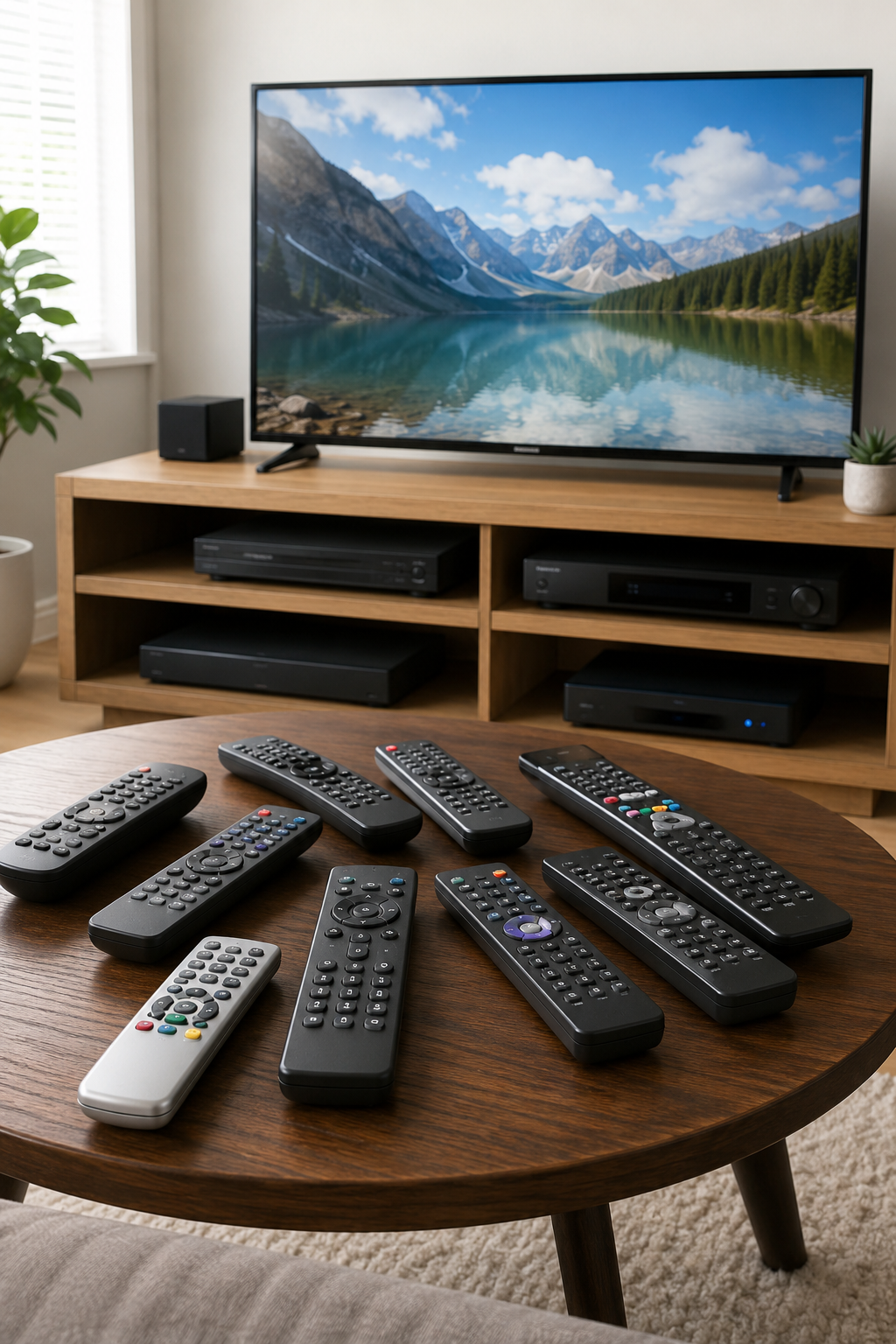
If you run a home studio, chances are you own more remote controls than microphones you actually use. Somewhere between the television, streaming box, monitor speakers and mystery gadget you forgot buying, there is always a little plastic controller quietly managing your evening. The TV remote feels so normal that we rarely stop to think about how clever it really is. Press a button, point in the general direction of the screen, and something happens - unless the batteries are flat or the remote has vanished into the same alternate dimension as missing guitar picks.
The earliest television remotes were surprisingly primitive. Before wireless convenience arrived, some remotes were physically attached to the television by cables, which certainly reduced walking but introduced a new sport called tripping over wires. In the 1950s, manufacturers began exploring wireless solutions and one of the most interesting involved ultrasonic technology. Instead of using light or radio signals, these remotes used high frequency sound beyond the range of normal human hearing. Pressing a button caused a small metal component inside the remote to vibrate at a particular ultrasonic frequency, and the television interpreted those sounds as commands like channel changes, volume adjustments or mute.
For anybody familiar with home studio technology, ultrasonic remotes sound oddly familiar. They were essentially early signal triggering systems where specific frequencies triggered specific actions. Clever as they were, they were not always perfectly behaved. Household noises, metallic sounds or jangling objects could sometimes confuse the system. Imagine your television unexpectedly changing channel because somebody dropped cutlery in the kitchen. Suddenly modern Bluetooth pairing does not seem quite so unreasonable.
Eventually, ultrasonic systems gave way to infrared technology, better known as IR. Instead of transmitting sound, IR remotes use invisible light generated by an infrared LED inside the handset. The television contains a sensor that receives these light pulses and decodes them into commands. Technically speaking, this is far more sophisticated than simply flashing a light on and off. Most infrared systems use pulse modulation techniques and carrier frequencies around 38 kHz, rapidly sending timed bursts of information containing binary command data. If you spend time around digital recording, MIDI timing or clock signals in a home studio, the concept is not far removed from encoding information into carefully timed signal patterns.
Unfortunately, manufacturers decided not to make life simple. Rather than agreeing on a universal infrared language, companies developed their own coding systems and protocols. Sony had one approach, Panasonic another, Philips another, and so on. Each manufacturer created proprietary command structures, timings and code sets. From a business perspective this made sense, but for ordinary users it created complete coffee table chaos. The television needed one remote, the cable box demanded another, the DVD player insisted on its own controls, and before long you needed a filing system just to watch a film.
Universal remotes arrived promising to save civilisation by replacing multiple controllers with a single device. Their mission was to learn, store and reproduce infrared commands from countless manufacturers. Some relied on massive code libraries while others used cloning or learning modes to capture signals directly from original remotes. In theory it was brilliant. In practice, users often spent evenings entering endless setup codes only to discover the power button worked beautifully while the menu function appeared to control something in another galaxy. The challenge came from the huge variety of infrared protocols, command lengths, carrier frequencies, device identifiers and timing structures that manufacturers had created over the years.
Modern television remotes increasingly use Bluetooth technology, especially with smart TVs and streaming devices. Unlike infrared, Bluetooth does not require line of sight, so you no longer need to point your remote precisely at the television like an exhausted wizard attempting electronic spellcasting. Bluetooth signals can travel around furniture, through rooms and support two way communication. That enables features such as voice search, device pairing, software integration and more advanced interaction. In many ways, today's smart remote is less a simple controller and more a compact wireless computer hiding inside a familiar plastic shell.
Yet despite decades of technical evolution, the remote control itself has barely changed. It remains a handheld rectangle packed with buttons, designed for comfortable operation from a safe seated distance. The reason is simple - the design works. In a home studio world already filled with software updates, audio routing puzzles, Bluetooth negotiations and cable collections that resemble archaeological excavation sites, there is something reassuring about the humble TV remote. From ultrasonic sound systems to infrared pulse wave modulation, proprietary coding wars, universal cloning headaches and modern Bluetooth control, the TV remote has quietly evolved into a surprisingly sophisticated piece of technology. And somehow, despite all that progress, we still spend ten minutes looking for it when the programme is about to start.
The earliest television remotes were surprisingly primitive. Before wireless convenience arrived, some remotes were physically attached to the television by cables, which certainly reduced walking but introduced a new sport called tripping over wires. In the 1950s, manufacturers began exploring wireless solutions and one of the most interesting involved ultrasonic technology. Instead of using light or radio signals, these remotes used high frequency sound beyond the range of normal human hearing. Pressing a button caused a small metal component inside the remote to vibrate at a particular ultrasonic frequency, and the television interpreted those sounds as commands like channel changes, volume adjustments or mute.
For anybody familiar with home studio technology, ultrasonic remotes sound oddly familiar. They were essentially early signal triggering systems where specific frequencies triggered specific actions. Clever as they were, they were not always perfectly behaved. Household noises, metallic sounds or jangling objects could sometimes confuse the system. Imagine your television unexpectedly changing channel because somebody dropped cutlery in the kitchen. Suddenly modern Bluetooth pairing does not seem quite so unreasonable.
Eventually, ultrasonic systems gave way to infrared technology, better known as IR. Instead of transmitting sound, IR remotes use invisible light generated by an infrared LED inside the handset. The television contains a sensor that receives these light pulses and decodes them into commands. Technically speaking, this is far more sophisticated than simply flashing a light on and off. Most infrared systems use pulse modulation techniques and carrier frequencies around 38 kHz, rapidly sending timed bursts of information containing binary command data. If you spend time around digital recording, MIDI timing or clock signals in a home studio, the concept is not far removed from encoding information into carefully timed signal patterns.
Unfortunately, manufacturers decided not to make life simple. Rather than agreeing on a universal infrared language, companies developed their own coding systems and protocols. Sony had one approach, Panasonic another, Philips another, and so on. Each manufacturer created proprietary command structures, timings and code sets. From a business perspective this made sense, but for ordinary users it created complete coffee table chaos. The television needed one remote, the cable box demanded another, the DVD player insisted on its own controls, and before long you needed a filing system just to watch a film.
Universal remotes arrived promising to save civilisation by replacing multiple controllers with a single device. Their mission was to learn, store and reproduce infrared commands from countless manufacturers. Some relied on massive code libraries while others used cloning or learning modes to capture signals directly from original remotes. In theory it was brilliant. In practice, users often spent evenings entering endless setup codes only to discover the power button worked beautifully while the menu function appeared to control something in another galaxy. The challenge came from the huge variety of infrared protocols, command lengths, carrier frequencies, device identifiers and timing structures that manufacturers had created over the years.
Modern television remotes increasingly use Bluetooth technology, especially with smart TVs and streaming devices. Unlike infrared, Bluetooth does not require line of sight, so you no longer need to point your remote precisely at the television like an exhausted wizard attempting electronic spellcasting. Bluetooth signals can travel around furniture, through rooms and support two way communication. That enables features such as voice search, device pairing, software integration and more advanced interaction. In many ways, today's smart remote is less a simple controller and more a compact wireless computer hiding inside a familiar plastic shell.
Yet despite decades of technical evolution, the remote control itself has barely changed. It remains a handheld rectangle packed with buttons, designed for comfortable operation from a safe seated distance. The reason is simple - the design works. In a home studio world already filled with software updates, audio routing puzzles, Bluetooth negotiations and cable collections that resemble archaeological excavation sites, there is something reassuring about the humble TV remote. From ultrasonic sound systems to infrared pulse wave modulation, proprietary coding wars, universal cloning headaches and modern Bluetooth control, the TV remote has quietly evolved into a surprisingly sophisticated piece of technology. And somehow, despite all that progress, we still spend ten minutes looking for it when the programme is about to start.
You may purchase items mentioned in this article here. Affiliate links earn me a commission at no extra cost to you. Thanks for supporting IanGardner.com