Wi-Fi Explained for Home Studios
A practical look at how Wi-Fi developed, why 2.4 GHz and 5 GHz behave differently, and when it's time to plug in a cable.
Ian Gardner is a British-American broadcaster, voice artist and audio enthusiast, sharing years of experience building creative workflows from a modern home studio. He helps readers make smarter buying decisions across studio gear, production tools and home comforts for both inside and outside the workspace. Broadcasters, podcasters, voice artists, producers and digital creators will find guidance that supports high production values and efficient workflows for building a successful home studio business. Similar articles can be found in the studio-essentials blog.
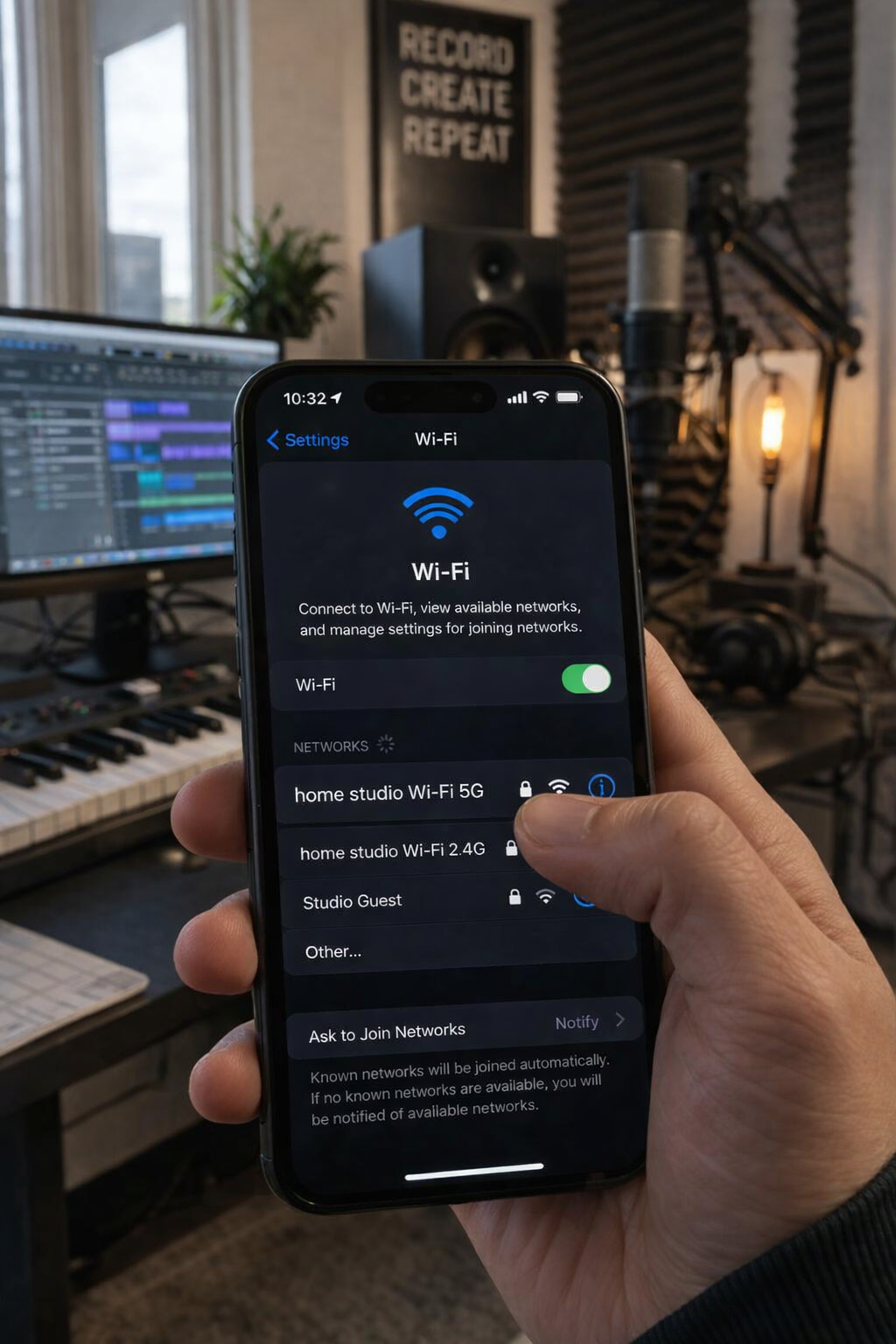
If you've ever sat in your home studio watching a file upload crawl while your creative energy disappears, you've already felt the importance of Wi-Fi - even if you didn't realize you were participating in a decades-long story of radio waves, engineering compromises, and some surprisingly clever branding. Wi-Fi feels invisible, almost magical, but its history is anything but simple. It is a story that starts long before your router started blinking in the corner of your studio.
The roots of Wi-Fi go back to the 1970s and 1980s, when engineers were experimenting with ways to send data over radio waves without wires. Early wireless networking concepts were clunky, slow, and mostly limited to industrial or military use. But by the late 1980s, regulatory bodies began opening up sections of the radio spectrum for unlicensed use. This decision was critical - it meant companies could build wireless devices without needing special permission, setting the stage for consumer-level wireless networking.
Enter the IEEE, or Institute of Electrical and Electronics Engineers. In 1997, they released the first official wireless networking standard - 802.11. It was not fast, topping out at about 2 Mbps, and it was not especially reliable. But it worked. This was Wi-Fi 1 in spirit, even if nobody called it that yet. Early adopters were not streaming audio or backing up sessions to the cloud - they were just excited to connect a laptop without plugging in a cable.
Around this time, something interesting happened with naming. The term Wi-Fi itself was introduced in 1999 by a marketing group called the Wireless Ethernet Compatibility Alliance, later renamed the Wi-Fi Alliance. Contrary to popular belief, Wi-Fi does not officially stand for Wireless Fidelity. That phrase was more of a backronym used for marketing. The real goal was to create a catchy, consumer-friendly name that felt as simple and universal as Hi-Fi. And it worked - massively.
The late 1990s and early 2000s saw rapid evolution. The 802.11b standard brought speeds up to 11 Mbps and operated on the 2.4 GHz band. This frequency had good range and could pass through walls relatively well, which made it ideal for home use. But it also had a downside - congestion. The 2.4 GHz band was already used by cordless phones, microwaves, and other devices, leading to interference issues that many home studio users still recognize today.
Then came 802.11a and 802.11g. 802.11a introduced the 5 GHz band, offering higher speeds and less interference, but with shorter range. 802.11g combined the best of both worlds by bringing higher speeds to the 2.4 GHz band. This period marked the transition from novelty to necessity. Suddenly, Wi-Fi was not just convenient - it was expected.
As standards evolved, the naming got more confusing. 802.11n, 802.11ac, 802.11ax - not exactly user-friendly. So the Wi-Fi Alliance simplified things by introducing generational names. 802.11n became Wi-Fi 4, 802.11ac became Wi-Fi 5, and 802.11ax became Wi-Fi 6. Earlier standards were retroactively labeled, so 802.11b is often considered Wi-Fi 1, even if that name came much later.
Wi-Fi 4 was a big leap, introducing MIMO - multiple input, multiple output - which allowed routers to use multiple antennas to send and receive data simultaneously. This significantly improved speed and reliability. For a home studio, this meant fewer dropouts when transferring large audio files or streaming reference tracks, especially when you are also working inside your DAW and managing sessions - something you can explore further in this guide to choosing a DAW.
Wi-Fi 5 pushed speeds even higher and made better use of the 5 GHz band. It was ideal for high-bandwidth tasks like streaming and large file transfers, but still struggled in crowded environments or through multiple walls. Then Wi-Fi 6 came along and changed the game again. It introduced technologies like OFDMA and improved MU-MIMO, allowing routers to handle many devices at once more efficiently. This was crucial in modern homes where dozens of devices compete for bandwidth - phones, tablets, smart speakers, and yes, your studio gear.
Now we are entering the era of Wi-Fi 7. This latest generation promises extremely high throughput, lower latency, and better performance in congested environments. It uses wider channels and can operate across multiple bands simultaneously. In theory, this means smoother real-time collaboration, faster uploads, and more reliable connections - all things that matter when you are working with clients remotely.
Speaking of bands, it is worth breaking down the difference between 2.4 GHz and 5 GHz Wi-Fi, because this directly impacts your home studio. The 2.4 GHz band offers longer range and better wall penetration, but it is slower and more prone to interference. The 5 GHz band is faster and less crowded, but its range is shorter. Newer systems also introduce 6 GHz, which is even faster and cleaner, but with even more limited range. Choosing the right band is a balancing act between speed and coverage.
One of the biggest modern challenges is congestion. Everyone has Wi-Fi now - not just in your house, but your neighbors too. In apartment buildings or dense neighborhoods, dozens of networks can overlap, all competing for the same channels. This leads to interference, slower speeds, and inconsistent performance. For a home studio, this can mean unstable connections during a remote session or slow uploads when delivering files.
This brings us to a practical reality that many audio professionals quietly accept - Wi-Fi is convenient, but wired connections are still king. A wired LAN connection offers lower latency, higher reliability, and consistent throughput. When you are doing remote voice direction, live streaming, or sending large multitrack sessions, that stability matters. Wi-Fi is fantastic for mobility and general use, but when precision and reliability are critical, an Ethernet cable is still your best friend.
So the next time your session buffers or your upload stalls, remember - you are not just dealing with a slow connection. You are interacting with decades of evolving technology, shared airwaves, and a system designed to balance convenience with complexity. And in your home studio, understanding that balance can make the difference between frustration and flow.
The roots of Wi-Fi go back to the 1970s and 1980s, when engineers were experimenting with ways to send data over radio waves without wires. Early wireless networking concepts were clunky, slow, and mostly limited to industrial or military use. But by the late 1980s, regulatory bodies began opening up sections of the radio spectrum for unlicensed use. This decision was critical - it meant companies could build wireless devices without needing special permission, setting the stage for consumer-level wireless networking.
Enter the IEEE, or Institute of Electrical and Electronics Engineers. In 1997, they released the first official wireless networking standard - 802.11. It was not fast, topping out at about 2 Mbps, and it was not especially reliable. But it worked. This was Wi-Fi 1 in spirit, even if nobody called it that yet. Early adopters were not streaming audio or backing up sessions to the cloud - they were just excited to connect a laptop without plugging in a cable.
Around this time, something interesting happened with naming. The term Wi-Fi itself was introduced in 1999 by a marketing group called the Wireless Ethernet Compatibility Alliance, later renamed the Wi-Fi Alliance. Contrary to popular belief, Wi-Fi does not officially stand for Wireless Fidelity. That phrase was more of a backronym used for marketing. The real goal was to create a catchy, consumer-friendly name that felt as simple and universal as Hi-Fi. And it worked - massively.
The late 1990s and early 2000s saw rapid evolution. The 802.11b standard brought speeds up to 11 Mbps and operated on the 2.4 GHz band. This frequency had good range and could pass through walls relatively well, which made it ideal for home use. But it also had a downside - congestion. The 2.4 GHz band was already used by cordless phones, microwaves, and other devices, leading to interference issues that many home studio users still recognize today.
Then came 802.11a and 802.11g. 802.11a introduced the 5 GHz band, offering higher speeds and less interference, but with shorter range. 802.11g combined the best of both worlds by bringing higher speeds to the 2.4 GHz band. This period marked the transition from novelty to necessity. Suddenly, Wi-Fi was not just convenient - it was expected.
As standards evolved, the naming got more confusing. 802.11n, 802.11ac, 802.11ax - not exactly user-friendly. So the Wi-Fi Alliance simplified things by introducing generational names. 802.11n became Wi-Fi 4, 802.11ac became Wi-Fi 5, and 802.11ax became Wi-Fi 6. Earlier standards were retroactively labeled, so 802.11b is often considered Wi-Fi 1, even if that name came much later.
Wi-Fi 4 was a big leap, introducing MIMO - multiple input, multiple output - which allowed routers to use multiple antennas to send and receive data simultaneously. This significantly improved speed and reliability. For a home studio, this meant fewer dropouts when transferring large audio files or streaming reference tracks, especially when you are also working inside your DAW and managing sessions - something you can explore further in this guide to choosing a DAW.
Wi-Fi 5 pushed speeds even higher and made better use of the 5 GHz band. It was ideal for high-bandwidth tasks like streaming and large file transfers, but still struggled in crowded environments or through multiple walls. Then Wi-Fi 6 came along and changed the game again. It introduced technologies like OFDMA and improved MU-MIMO, allowing routers to handle many devices at once more efficiently. This was crucial in modern homes where dozens of devices compete for bandwidth - phones, tablets, smart speakers, and yes, your studio gear.
Now we are entering the era of Wi-Fi 7. This latest generation promises extremely high throughput, lower latency, and better performance in congested environments. It uses wider channels and can operate across multiple bands simultaneously. In theory, this means smoother real-time collaboration, faster uploads, and more reliable connections - all things that matter when you are working with clients remotely.
Speaking of bands, it is worth breaking down the difference between 2.4 GHz and 5 GHz Wi-Fi, because this directly impacts your home studio. The 2.4 GHz band offers longer range and better wall penetration, but it is slower and more prone to interference. The 5 GHz band is faster and less crowded, but its range is shorter. Newer systems also introduce 6 GHz, which is even faster and cleaner, but with even more limited range. Choosing the right band is a balancing act between speed and coverage.
One of the biggest modern challenges is congestion. Everyone has Wi-Fi now - not just in your house, but your neighbors too. In apartment buildings or dense neighborhoods, dozens of networks can overlap, all competing for the same channels. This leads to interference, slower speeds, and inconsistent performance. For a home studio, this can mean unstable connections during a remote session or slow uploads when delivering files.
This brings us to a practical reality that many audio professionals quietly accept - Wi-Fi is convenient, but wired connections are still king. A wired LAN connection offers lower latency, higher reliability, and consistent throughput. When you are doing remote voice direction, live streaming, or sending large multitrack sessions, that stability matters. Wi-Fi is fantastic for mobility and general use, but when precision and reliability are critical, an Ethernet cable is still your best friend.
So the next time your session buffers or your upload stalls, remember - you are not just dealing with a slow connection. You are interacting with decades of evolving technology, shared airwaves, and a system designed to balance convenience with complexity. And in your home studio, understanding that balance can make the difference between frustration and flow.
You may purchase items mentioned in this article here. Affiliate links earn me a commission at no extra cost to you. Thanks for supporting IanGardner.com