Understanding Studio Power
Why North America runs on 120V 60Hz and how decisions from the 1800s still shape your home studio today.
Ian Gardner is a British-American broadcaster, voice artist and audio enthusiast, sharing years of experience building creative workflows from a modern home studio. He helps readers make smarter buying decisions across studio gear, production tools and home comforts for both inside and outside the workspace. Broadcasters, podcasters, voice artists, producers and digital creators will find guidance that supports high production values and efficient workflows for building a successful home studio business. Similar articles can be found in the home-essentials blog.
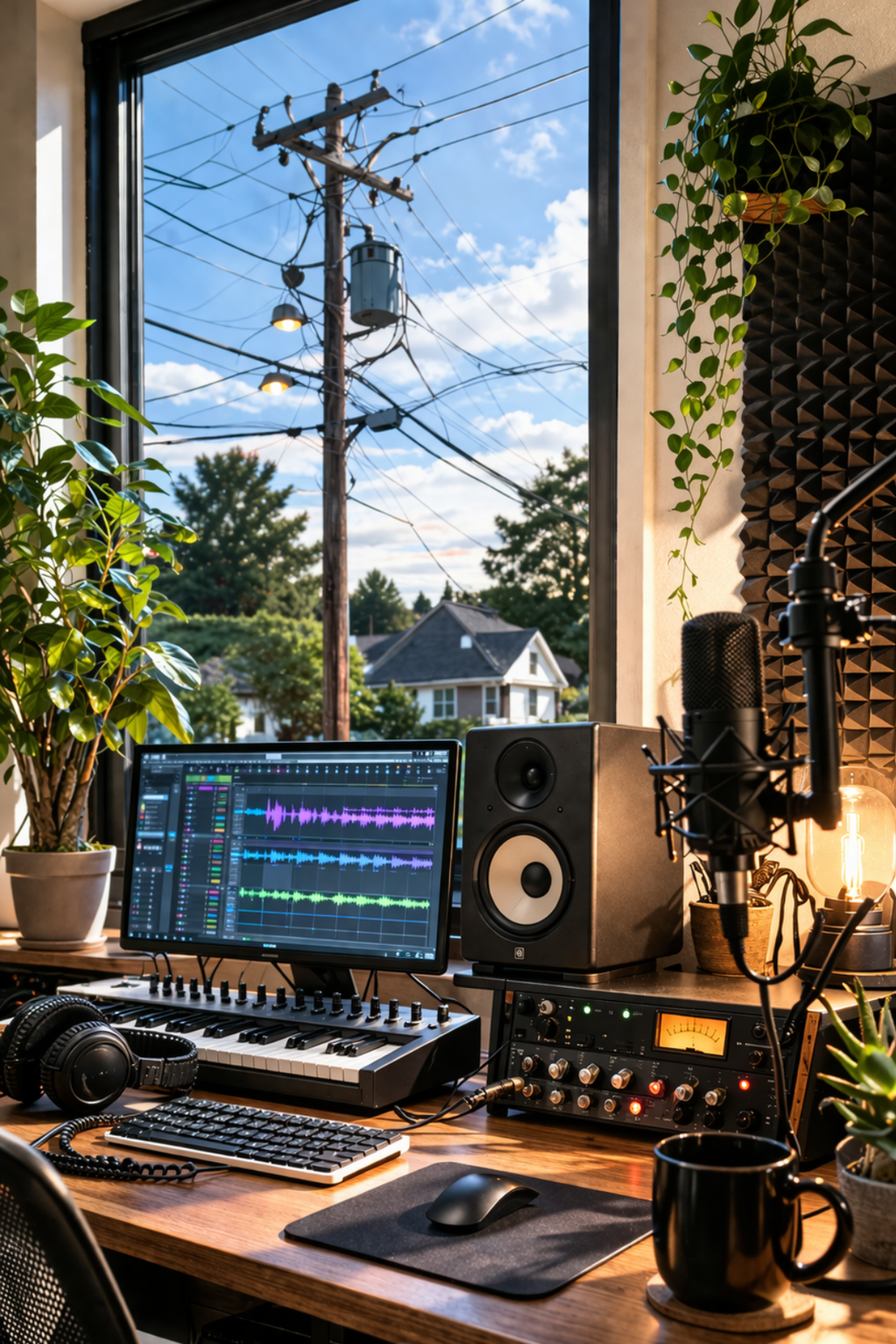
If you've ever plugged in your audio interface, powered up your monitors, and watched your home studio come to life, you've participated in one of the most quietly complex systems ever built - the electrical grid. It's easy to take for granted. Flip a switch, things turn on. But behind that simple action is a century-plus of engineering decisions, rivalries, compromises, and just enough chaos to make you wonder how your gear isn't constantly frying itself.
Let's rewind to the late 1800s, when electricity was less about convenience and more about proving whose idea was better. On one side you had Thomas Edison, championing direct current (DC). On the other, Nikola Tesla and George Westinghouse pushing alternating current (AC). Edison's DC worked, but only over short distances. That meant power stations every mile or so - not exactly scalable. AC, on the other hand, could be transformed to higher voltages for long-distance transmission and then stepped back down for safe use in homes. That flexibility won, and AC became the backbone of modern power distribution.
So why 120 volts and 60 hertz in North America? The answer is a mix of technical limitation and historical inertia. Early incandescent light bulbs worked well around 100-120 volts, and once infrastructure started rolling out, it stuck. Frequency - measured in hertz - landed at 60 cycles per second partly because it was a sweet spot between efficient transformer operation and minimizing flicker in lighting. Once utilities invested billions into that standard, changing it became practically impossible. Your studio monitors today are, in a way, still tied to decisions made for light bulbs over a century ago.
Now let's talk about how that power actually gets to your studio. Electricity is generated at power plants, often at relatively low voltages, then stepped up using transformers to extremely high voltages - sometimes hundreds of thousands of volts - for transmission across long distances. High voltage means lower current for the same power, which reduces energy loss as heat in the wires. When it gets closer to your neighborhood, substations step that voltage back down, and finally a transformer on a pole or in a ground box drops it to the 120/240 volts your home uses.
Here's where it gets interesting. Most North American homes don't just get a single 120 volt line. They actually receive split-phase power. This means you have two 120 volt lines that are 180 degrees out of phase with each other. Between either line and neutral, you get 120 volts. Between the two hot lines, you get 240 volts. That's how your house can power both your laptop charger and something more demanding like an electric dryer or oven.
For a home studio, most of your gear runs happily on 120 volts. Interfaces, mixers, preamps, and even powered monitors are designed with that in mind. But higher power devices - like large amplifiers or certain rack gear with hefty transformers - can sometimes benefit from 240 volt circuits. Not because they need more voltage per se, but because delivering the same power at higher voltage means lower current, which reduces stress on wiring and can improve efficiency.
You'll also see 240 volts come into play more often now with electric vehicles. Installing a Level 2 EV charger at home typically requires a dedicated 240 volt circuit. That's essentially the same principle as your dryer outlet, just repurposed for faster charging. If you're running a studio and adding EV charging, it's worth thinking about your electrical panel capacity. You don't want your late-night mix session competing with your car for power.
Across the pond, things look a bit different. The UK and much of Europe standardized on 230-240 volts at 50 hertz. Higher voltage means lower current for the same power, which allows for thinner wiring and can be more efficient in distribution. However, it also means stricter safety requirements. That's why UK plugs are bulkier and include built-in fuses. For audio gear, the difference in frequency - 50 Hz vs 60 Hz - can matter for devices with motors or certain types of power supplies, though most modern equipment uses switch-mode power supplies that can handle a wide range of inputs seamlessly.
Speaking of power supplies, the ones inside your gear have evolved dramatically. Older linear power supplies were heavy, relying on large transformers tuned to the local mains frequency. That's why vintage gear often feels like it's made of bricks. Modern switch-mode power supplies are lighter and more flexible, converting incoming AC to DC and then rapidly switching it to achieve the desired output. They're efficient and universal, which is why your laptop charger works almost anywhere in the world with just a plug adapter.
Of course, all this complexity comes with risks. Voltage spikes, brownouts, surges, and even full outages can wreak havoc on sensitive audio equipment and your workflow. If you've ever lost a take or heard a nasty pop through your monitors during a storm, you know the pain. I go deeper into that in another post - if you want to protect your setup, check out Surge Happens for a practical look at surge protection, and if you're thinking about what happens when the power goes out completely, this guide to surviving a power outage covers how to stay up and running when the grid doesn't cooperate.
So was 120 volts at 60 hertz the right call? From a modern perspective, you could argue either way. Higher voltage systems like those in Europe are arguably more efficient, but North America's split-phase system offers flexibility and has proven remarkably resilient. The real takeaway is that once a standard is widely adopted, it becomes incredibly difficult to change. Your home studio isn't just plugged into the wall - it's plugged into history. And despite all the quirks and compromises, it works well enough that you can focus on what actually matters - making great audio.
Let's rewind to the late 1800s, when electricity was less about convenience and more about proving whose idea was better. On one side you had Thomas Edison, championing direct current (DC). On the other, Nikola Tesla and George Westinghouse pushing alternating current (AC). Edison's DC worked, but only over short distances. That meant power stations every mile or so - not exactly scalable. AC, on the other hand, could be transformed to higher voltages for long-distance transmission and then stepped back down for safe use in homes. That flexibility won, and AC became the backbone of modern power distribution.
So why 120 volts and 60 hertz in North America? The answer is a mix of technical limitation and historical inertia. Early incandescent light bulbs worked well around 100-120 volts, and once infrastructure started rolling out, it stuck. Frequency - measured in hertz - landed at 60 cycles per second partly because it was a sweet spot between efficient transformer operation and minimizing flicker in lighting. Once utilities invested billions into that standard, changing it became practically impossible. Your studio monitors today are, in a way, still tied to decisions made for light bulbs over a century ago.
Now let's talk about how that power actually gets to your studio. Electricity is generated at power plants, often at relatively low voltages, then stepped up using transformers to extremely high voltages - sometimes hundreds of thousands of volts - for transmission across long distances. High voltage means lower current for the same power, which reduces energy loss as heat in the wires. When it gets closer to your neighborhood, substations step that voltage back down, and finally a transformer on a pole or in a ground box drops it to the 120/240 volts your home uses.
Here's where it gets interesting. Most North American homes don't just get a single 120 volt line. They actually receive split-phase power. This means you have two 120 volt lines that are 180 degrees out of phase with each other. Between either line and neutral, you get 120 volts. Between the two hot lines, you get 240 volts. That's how your house can power both your laptop charger and something more demanding like an electric dryer or oven.
For a home studio, most of your gear runs happily on 120 volts. Interfaces, mixers, preamps, and even powered monitors are designed with that in mind. But higher power devices - like large amplifiers or certain rack gear with hefty transformers - can sometimes benefit from 240 volt circuits. Not because they need more voltage per se, but because delivering the same power at higher voltage means lower current, which reduces stress on wiring and can improve efficiency.
You'll also see 240 volts come into play more often now with electric vehicles. Installing a Level 2 EV charger at home typically requires a dedicated 240 volt circuit. That's essentially the same principle as your dryer outlet, just repurposed for faster charging. If you're running a studio and adding EV charging, it's worth thinking about your electrical panel capacity. You don't want your late-night mix session competing with your car for power.
Across the pond, things look a bit different. The UK and much of Europe standardized on 230-240 volts at 50 hertz. Higher voltage means lower current for the same power, which allows for thinner wiring and can be more efficient in distribution. However, it also means stricter safety requirements. That's why UK plugs are bulkier and include built-in fuses. For audio gear, the difference in frequency - 50 Hz vs 60 Hz - can matter for devices with motors or certain types of power supplies, though most modern equipment uses switch-mode power supplies that can handle a wide range of inputs seamlessly.
Speaking of power supplies, the ones inside your gear have evolved dramatically. Older linear power supplies were heavy, relying on large transformers tuned to the local mains frequency. That's why vintage gear often feels like it's made of bricks. Modern switch-mode power supplies are lighter and more flexible, converting incoming AC to DC and then rapidly switching it to achieve the desired output. They're efficient and universal, which is why your laptop charger works almost anywhere in the world with just a plug adapter.
Of course, all this complexity comes with risks. Voltage spikes, brownouts, surges, and even full outages can wreak havoc on sensitive audio equipment and your workflow. If you've ever lost a take or heard a nasty pop through your monitors during a storm, you know the pain. I go deeper into that in another post - if you want to protect your setup, check out Surge Happens for a practical look at surge protection, and if you're thinking about what happens when the power goes out completely, this guide to surviving a power outage covers how to stay up and running when the grid doesn't cooperate.
So was 120 volts at 60 hertz the right call? From a modern perspective, you could argue either way. Higher voltage systems like those in Europe are arguably more efficient, but North America's split-phase system offers flexibility and has proven remarkably resilient. The real takeaway is that once a standard is widely adopted, it becomes incredibly difficult to change. Your home studio isn't just plugged into the wall - it's plugged into history. And despite all the quirks and compromises, it works well enough that you can focus on what actually matters - making great audio.
You may purchase items mentioned in this article here. Affiliate links earn me a commission at no extra cost to you. Thanks for supporting IanGardner.com