Surge Happens
Power spikes are more common than most people think. From snow storms to grid fluctuations, surge protection helps keep expensive home studio gear safe and running.
Ian Gardner is a British-American broadcaster, voice artist and audio enthusiast, sharing years of experience building creative workflows from a modern home studio. He helps readers make smarter buying decisions across studio gear, production tools and home comforts for both inside and outside the workspace. Broadcasters, podcasters, voice artists, producers and digital creators will find guidance that supports high production values and efficient workflows for building a successful home studio business. Similar articles can be found in the studio-essentials blog.
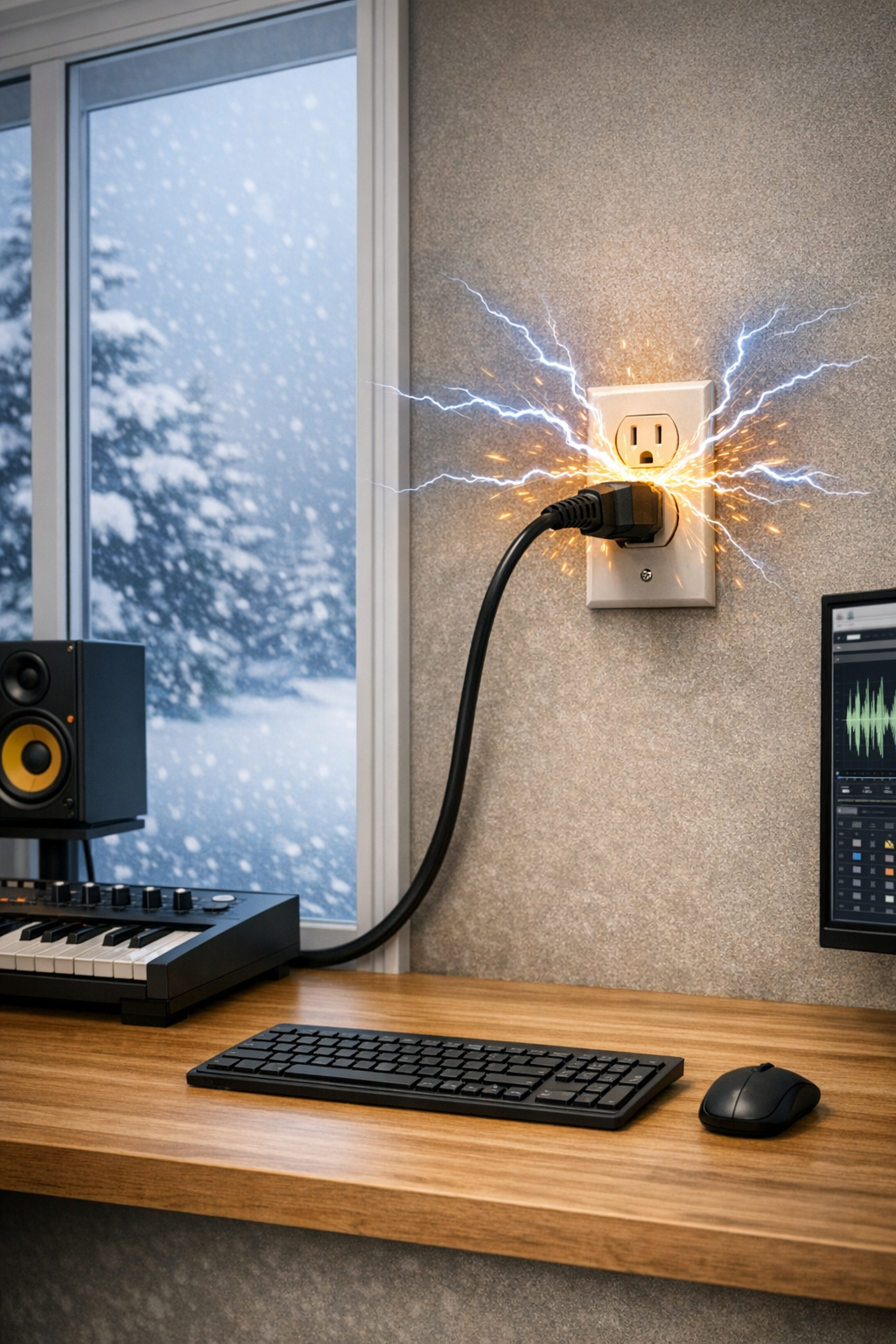
Surge protection devices have become a quiet but essential part of the modern home studio. Musicians, podcasters, voiceover artists, and content creators rely on sensitive electronic equipment that can be damaged instantly by unstable power. The power strip with built in surge protection - a common sight under desks and behind racks - has its roots in a long history of electrical safety innovation. While they may look simple, these devices play a crucial role in protecting valuable studio gear from voltage spikes, electrical noise, and sudden power disturbances that occur on residential power lines.
The concept of surge protection dates back to the expansion of consumer electronics in the late twentieth century. As televisions, stereos, and personal computers became common household devices in the 1970s and 1980s, engineers realized that standard electrical outlets provided no protection against sudden increases in voltage. These spikes could be caused by lightning strikes, switching operations within the power grid, or even large appliances turning on and off inside the same home. Power strips evolved from simple multi outlet extension devices into protective systems that included metal oxide varistors and other components designed to absorb excess voltage before it could reach connected equipment.
In a home studio environment, surge protection is particularly important because audio equipment is both expensive and sensitive. Digital audio interfaces, studio monitors, mixers, synthesizers, computers, and external hard drives all rely on stable power. A sudden voltage spike can destroy power supplies, corrupt hard drives, or damage delicate integrated circuits. Even a small spike that does not immediately destroy equipment can weaken components over time, eventually causing mysterious failures. For creators who rely on their gear every day, a good surge protector acts as the first line of defense between the electrical grid and thousands of dollars worth of equipment.
Voltage spikes themselves are surprisingly common. They are often brief - lasting only microseconds - but during that moment the voltage in a line can jump far beyond the safe 120 volt level typical in North American homes. Lightning strikes are one dramatic cause, but they are not the only one. When a power company restores service after an outage, when large motors start up, or when grid equipment switches loads, brief surges can travel through power lines and into homes. Without surge protection, these spikes go directly into connected electronics, where they can instantly overwhelm internal circuitry.
Living in Minnesota makes this topic especially relevant. The state's weather creates two different seasonal risks for power disturbances. In the summer, thunderstorms frequently bring lightning and strong winds that can knock down power lines or cause sudden surges as the electrical grid responds to lightning strikes. In the winter, heavy snow, ice buildup, and extreme cold can also damage infrastructure and cause outages. When power is restored after one of these weather related events, voltage fluctuations often occur. For anyone running a home studio in Minnesota, protecting gear against these unpredictable conditions is simply practical risk management.
Safety certification is another important factor when choosing a surge protection device. Not all power strips provide true surge protection, and not all are built to the same safety standards. Reliable products typically carry certification marks from organizations such as UL or ETL, indicating that the device has been tested for electrical safety and surge suppression capability. The joule rating listed on surge protectors represents how much energy the device can absorb before it fails. Higher joule ratings generally indicate greater protective capacity, which is particularly useful when powering multiple devices in a studio setup.
Surge protection is not limited to studio gear either. Many homeowners now use protective power strips throughout the house for televisions, computers, game consoles, and networking equipment. In my own setup, surge protection is used across a wide range of appliances including refrigerators, TVs, and other electronics that would be expensive or inconvenient to replace. While large appliances often have some internal protection, an external surge protector adds another layer of security. Considering how much modern households depend on electronics, protecting them from unpredictable electrical events makes practical and financial sense.
For home studio owners, the lesson is straightforward - power quality matters just as much as microphone quality or acoustic treatment. A stable electrical supply protects recordings, preserves hardware, and prevents costly downtime. Investing in a properly rated surge protector is one of the simplest and most affordable ways to safeguard a studio environment. In my own studio I use the Belkin Surge Protector Power Strip with 12 outlets, because there are simply so many devices that need power in a modern setup. Between audio interfaces, monitors, computers, chargers, and all the little gadgets that quietly accumulate over time, the outlet count fills up quickly - and it is nice knowing everything is plugged in safely while the audio keeps playing.
The concept of surge protection dates back to the expansion of consumer electronics in the late twentieth century. As televisions, stereos, and personal computers became common household devices in the 1970s and 1980s, engineers realized that standard electrical outlets provided no protection against sudden increases in voltage. These spikes could be caused by lightning strikes, switching operations within the power grid, or even large appliances turning on and off inside the same home. Power strips evolved from simple multi outlet extension devices into protective systems that included metal oxide varistors and other components designed to absorb excess voltage before it could reach connected equipment.
In a home studio environment, surge protection is particularly important because audio equipment is both expensive and sensitive. Digital audio interfaces, studio monitors, mixers, synthesizers, computers, and external hard drives all rely on stable power. A sudden voltage spike can destroy power supplies, corrupt hard drives, or damage delicate integrated circuits. Even a small spike that does not immediately destroy equipment can weaken components over time, eventually causing mysterious failures. For creators who rely on their gear every day, a good surge protector acts as the first line of defense between the electrical grid and thousands of dollars worth of equipment.
Voltage spikes themselves are surprisingly common. They are often brief - lasting only microseconds - but during that moment the voltage in a line can jump far beyond the safe 120 volt level typical in North American homes. Lightning strikes are one dramatic cause, but they are not the only one. When a power company restores service after an outage, when large motors start up, or when grid equipment switches loads, brief surges can travel through power lines and into homes. Without surge protection, these spikes go directly into connected electronics, where they can instantly overwhelm internal circuitry.
Living in Minnesota makes this topic especially relevant. The state's weather creates two different seasonal risks for power disturbances. In the summer, thunderstorms frequently bring lightning and strong winds that can knock down power lines or cause sudden surges as the electrical grid responds to lightning strikes. In the winter, heavy snow, ice buildup, and extreme cold can also damage infrastructure and cause outages. When power is restored after one of these weather related events, voltage fluctuations often occur. For anyone running a home studio in Minnesota, protecting gear against these unpredictable conditions is simply practical risk management.
Safety certification is another important factor when choosing a surge protection device. Not all power strips provide true surge protection, and not all are built to the same safety standards. Reliable products typically carry certification marks from organizations such as UL or ETL, indicating that the device has been tested for electrical safety and surge suppression capability. The joule rating listed on surge protectors represents how much energy the device can absorb before it fails. Higher joule ratings generally indicate greater protective capacity, which is particularly useful when powering multiple devices in a studio setup.
Surge protection is not limited to studio gear either. Many homeowners now use protective power strips throughout the house for televisions, computers, game consoles, and networking equipment. In my own setup, surge protection is used across a wide range of appliances including refrigerators, TVs, and other electronics that would be expensive or inconvenient to replace. While large appliances often have some internal protection, an external surge protector adds another layer of security. Considering how much modern households depend on electronics, protecting them from unpredictable electrical events makes practical and financial sense.
For home studio owners, the lesson is straightforward - power quality matters just as much as microphone quality or acoustic treatment. A stable electrical supply protects recordings, preserves hardware, and prevents costly downtime. Investing in a properly rated surge protector is one of the simplest and most affordable ways to safeguard a studio environment. In my own studio I use the Belkin Surge Protector Power Strip with 12 outlets, because there are simply so many devices that need power in a modern setup. Between audio interfaces, monitors, computers, chargers, and all the little gadgets that quietly accumulate over time, the outlet count fills up quickly - and it is nice knowing everything is plugged in safely while the audio keeps playing.
You may purchase items mentioned in this article here. Affiliate links earn me a commission at no extra cost to you. Thanks for supporting IanGardner.com