Please Record My Show!
Explore the history of recording TV shows, from VHS and Betamax to DVRs, streaming services and life beyond appointment viewing.
Ian Gardner is a British-American broadcaster, voice artist and audio enthusiast, sharing years of experience building creative workflows from a modern home studio. He helps readers make smarter buying decisions across studio gear, production tools and home comforts for both inside and outside the workspace. Broadcasters, podcasters, voice artists, producers and digital creators will find guidance that supports high production values and efficient workflows for building a successful home studio business. Similar articles can be found in the televisions blog.
Once upon a time, television was appointment viewing in the truest sense of the phrase. If your favourite programme started at 8pm on Thursday night, you arranged your evening around it, finished dinner on time, and made sure somebody else wasn't using the television. There were relatively few channels, which meant huge audiences gathered around the same programmes at the same time, and missing an episode could leave you completely out of the conversation the next day. For anyone interested in home studios, it was a little like live broadcasting or recording onto tape - timing mattered, there were no second chances, and you needed to be ready when the moment arrived.
Then came the video cassette recorder, and suddenly television no longer had complete control over your schedule. The VCR allowed people to record programmes and watch them later, which sounds perfectly ordinary today but felt remarkably futuristic at the time. For the first time, viewers could go out for the evening without sacrificing their favourite series, and families began building personal libraries of television recordings. The machine itself became a familiar part of the living room, humming quietly beneath the TV while promising a new age of freedom, convenience, and occasional technical confusion.
Before people could fully enjoy this new recording revolution, they first had to navigate one of consumer electronics' most memorable battles - VHS versus Betamax. The rivalry inspired endless debates between friends, neighbors, and self-appointed technology experts who all had strong opinions about picture quality, recording times, and which format represented the future. Betamax had its supporters and plenty of technical strengths, but VHS ultimately won the format war and became the standard household choice. Looking back, it feels surprisingly similar to modern arguments about software platforms, audio formats, or recording workflows in the home studio world.
Living through the VCR era also meant living with enormous collections of blank tapes. Many households had cupboards, shelves, or drawers packed with recordable cassettes, often decorated with handwritten labels that ranged from impressively organised to completely mysterious. Somewhere among the carefully marked movie recordings and television specials would be a tape labelled something like 'DO NOT ERASE', which naturally increased the odds that somebody would eventually erase it. Recording television was a physical activity in those days, involving real media, real storage space, and real opportunities for accidental disaster.
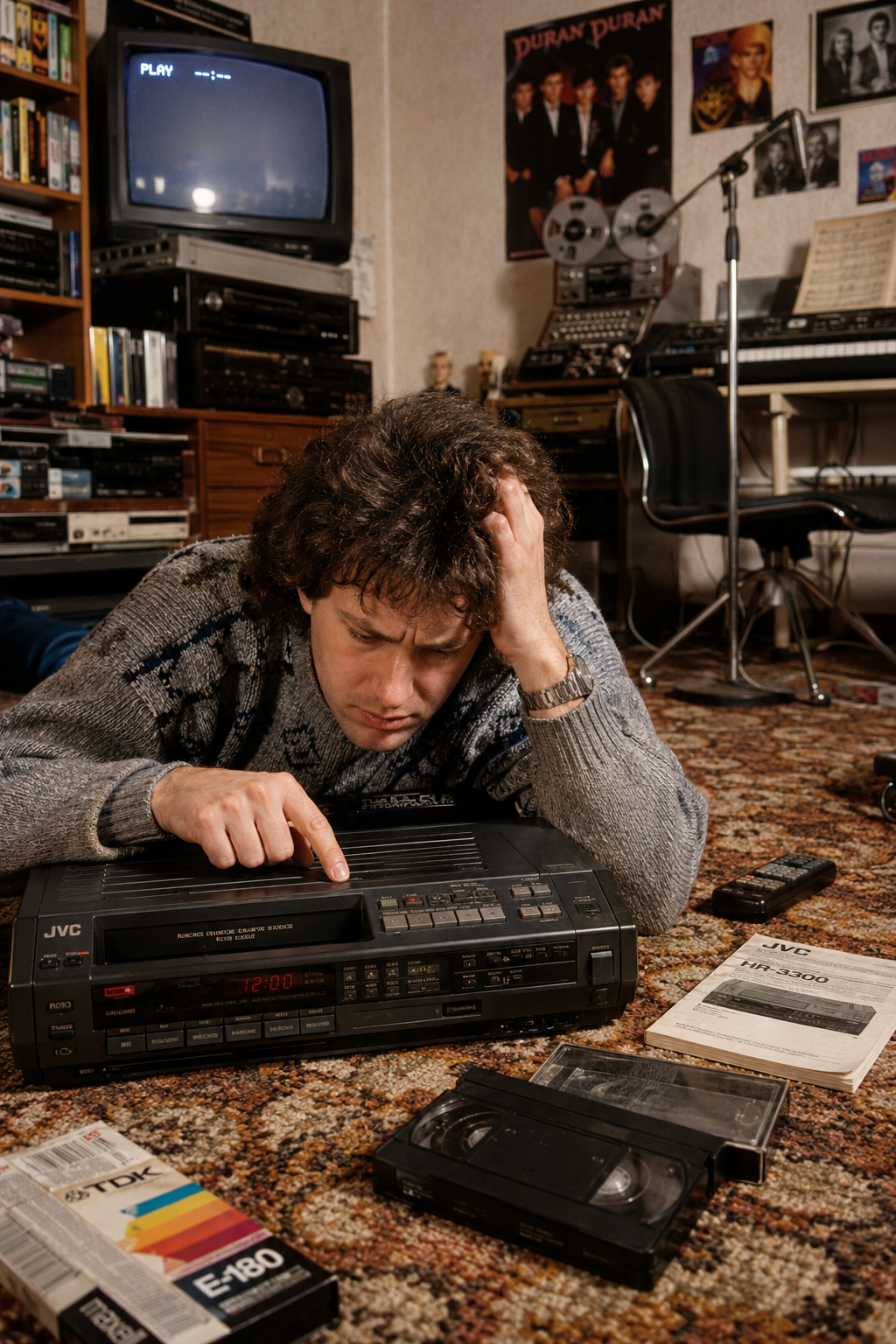
Programming a VCR became one of the great technological challenges of ordinary domestic life. The process involved tiny buttons, blinking displays, confusing manuals, and a level of concentration normally associated with assembling furniture or setting up complicated audio equipment. A wrong date, a missed channel number, or forgetting to insert a tape could easily destroy your recording plans without warning. Home studio enthusiasts may recognise the feeling immediately because it resembles the experience of configuring signal routing, sample rates, or menu settings that somehow refuse to cooperate until long after midnight.
Despite the frustrations, people grew surprisingly attached to their recording systems because they offered something television had never really provided before - control. You could save a movie for the weekend, record a late night programme while you slept, or create a collection of favourite shows that existed entirely on your own shelves. Fast forwarding became a routine skill, rewinding became a household ritual, and everybody developed strong opinions about tape quality and recording speed. It was slightly awkward, occasionally unreliable, and enormously satisfying when everything actually worked.
The next major leap arrived when television recording moved away from magnetic tape and embraced digital storage. Hard drive based recording changed the entire experience from a mildly stressful technical exercise into something much smoother and easier to manage. One of the most influential names in this transition was TiVo, which helped popularise the idea that recording television should be simple, clever, and almost effortless. Instead of hunting for blank tapes and calculating recording lengths, viewers could store programmes digitally and browse them with a level of convenience that felt revolutionary.
The real magic of the DVR era came from its connection to the electronic programme guide, or EPG. Rather than manually entering dates, times, and channels like you were completing an administrative form, you could simply scroll through a guide, choose a programme, and press record. If you wanted an entire series recorded automatically, the system could handle that as well, which seemed astonishingly intelligent at the time. For anyone familiar with the transition from analogue studios to digital production, this shift felt very familiar because technology was beginning to hide the complicated mechanics and present users with a much friendlier interface.
Not every format transition achieved the same level of success, however, and recordable DVDs never quite became the television recording solution many people expected. On paper they sounded ideal because they offered digital quality in a tidy, physical format that looked cleaner and more modern than shelves of ageing videotapes. In practice, the process could be fiddly, hard drive recording was easier, and internet delivery was rapidly becoming impossible to ignore. Recordable DVDs found their place in some homes, but they never dominated television recording in the way VHS or DVR systems had done.
Eventually, the entire concept of recording began to change because catch-up streaming services altered the relationship between viewers and television itself. Instead of recording a programme for later viewing, people increasingly expected broadcasters to make shows available online whenever convenient. Programmes no longer needed to live on tapes, discs, or hard drives because they existed somewhere in the cloud, ready to appear on demand with the tap of a screen or click of a mouse. The idea of missing a programme started to fade because access had become more important than ownership.
At the same time, television viewing migrated away from the traditional living room experience and spread across laptops, tablets, and smartphones. Shows became easier to consume in smaller pieces, clips became shareable, and catch-up viewing evolved into bite sized highlights on YouTube and social media platforms. What began as families gathering around a single television at a fixed hour slowly transformed into highly personalised viewing habits scattered across multiple devices and different moments of the day. In many ways, the history of recording television mirrors the story of the home studio itself, moving from rigid schedules and physical media toward flexibility, portability, and increasingly invisible technology.
Even so, there remains something oddly charming about those earlier eras of television recording. The blinking VCR clock stuck permanently on 12:00, the towering collection of labelled tapes, and the small feeling of triumph when a carefully programmed recording actually succeeded all retain a certain nostalgic appeal. Today's programmes may live comfortably in streaming libraries, recommendation engines, and cloud services, but they owe a great deal to decades of experimentation, technical frustration, and determined viewers who simply didn't want to miss their favourite show. The history of recording TV turns out to be far more entertaining than you might expect, especially when you realise it began with millions of people racing home to avoid missing a programme altogether.
Then came the video cassette recorder, and suddenly television no longer had complete control over your schedule. The VCR allowed people to record programmes and watch them later, which sounds perfectly ordinary today but felt remarkably futuristic at the time. For the first time, viewers could go out for the evening without sacrificing their favourite series, and families began building personal libraries of television recordings. The machine itself became a familiar part of the living room, humming quietly beneath the TV while promising a new age of freedom, convenience, and occasional technical confusion.
Before people could fully enjoy this new recording revolution, they first had to navigate one of consumer electronics' most memorable battles - VHS versus Betamax. The rivalry inspired endless debates between friends, neighbors, and self-appointed technology experts who all had strong opinions about picture quality, recording times, and which format represented the future. Betamax had its supporters and plenty of technical strengths, but VHS ultimately won the format war and became the standard household choice. Looking back, it feels surprisingly similar to modern arguments about software platforms, audio formats, or recording workflows in the home studio world.
Living through the VCR era also meant living with enormous collections of blank tapes. Many households had cupboards, shelves, or drawers packed with recordable cassettes, often decorated with handwritten labels that ranged from impressively organised to completely mysterious. Somewhere among the carefully marked movie recordings and television specials would be a tape labelled something like 'DO NOT ERASE', which naturally increased the odds that somebody would eventually erase it. Recording television was a physical activity in those days, involving real media, real storage space, and real opportunities for accidental disaster.
Programming a VCR became one of the great technological challenges of ordinary domestic life. The process involved tiny buttons, blinking displays, confusing manuals, and a level of concentration normally associated with assembling furniture or setting up complicated audio equipment. A wrong date, a missed channel number, or forgetting to insert a tape could easily destroy your recording plans without warning. Home studio enthusiasts may recognise the feeling immediately because it resembles the experience of configuring signal routing, sample rates, or menu settings that somehow refuse to cooperate until long after midnight.
Despite the frustrations, people grew surprisingly attached to their recording systems because they offered something television had never really provided before - control. You could save a movie for the weekend, record a late night programme while you slept, or create a collection of favourite shows that existed entirely on your own shelves. Fast forwarding became a routine skill, rewinding became a household ritual, and everybody developed strong opinions about tape quality and recording speed. It was slightly awkward, occasionally unreliable, and enormously satisfying when everything actually worked.
The next major leap arrived when television recording moved away from magnetic tape and embraced digital storage. Hard drive based recording changed the entire experience from a mildly stressful technical exercise into something much smoother and easier to manage. One of the most influential names in this transition was TiVo, which helped popularise the idea that recording television should be simple, clever, and almost effortless. Instead of hunting for blank tapes and calculating recording lengths, viewers could store programmes digitally and browse them with a level of convenience that felt revolutionary.
The real magic of the DVR era came from its connection to the electronic programme guide, or EPG. Rather than manually entering dates, times, and channels like you were completing an administrative form, you could simply scroll through a guide, choose a programme, and press record. If you wanted an entire series recorded automatically, the system could handle that as well, which seemed astonishingly intelligent at the time. For anyone familiar with the transition from analogue studios to digital production, this shift felt very familiar because technology was beginning to hide the complicated mechanics and present users with a much friendlier interface.
Not every format transition achieved the same level of success, however, and recordable DVDs never quite became the television recording solution many people expected. On paper they sounded ideal because they offered digital quality in a tidy, physical format that looked cleaner and more modern than shelves of ageing videotapes. In practice, the process could be fiddly, hard drive recording was easier, and internet delivery was rapidly becoming impossible to ignore. Recordable DVDs found their place in some homes, but they never dominated television recording in the way VHS or DVR systems had done.
Eventually, the entire concept of recording began to change because catch-up streaming services altered the relationship between viewers and television itself. Instead of recording a programme for later viewing, people increasingly expected broadcasters to make shows available online whenever convenient. Programmes no longer needed to live on tapes, discs, or hard drives because they existed somewhere in the cloud, ready to appear on demand with the tap of a screen or click of a mouse. The idea of missing a programme started to fade because access had become more important than ownership.
At the same time, television viewing migrated away from the traditional living room experience and spread across laptops, tablets, and smartphones. Shows became easier to consume in smaller pieces, clips became shareable, and catch-up viewing evolved into bite sized highlights on YouTube and social media platforms. What began as families gathering around a single television at a fixed hour slowly transformed into highly personalised viewing habits scattered across multiple devices and different moments of the day. In many ways, the history of recording television mirrors the story of the home studio itself, moving from rigid schedules and physical media toward flexibility, portability, and increasingly invisible technology.
Even so, there remains something oddly charming about those earlier eras of television recording. The blinking VCR clock stuck permanently on 12:00, the towering collection of labelled tapes, and the small feeling of triumph when a carefully programmed recording actually succeeded all retain a certain nostalgic appeal. Today's programmes may live comfortably in streaming libraries, recommendation engines, and cloud services, but they owe a great deal to decades of experimentation, technical frustration, and determined viewers who simply didn't want to miss their favourite show. The history of recording TV turns out to be far more entertaining than you might expect, especially when you realise it began with millions of people racing home to avoid missing a programme altogether.
You may purchase items mentioned in this article here. Affiliate links earn me a commission at no extra cost to you. Thanks for supporting IanGardner.com