Drawing the Line
From early on-screen captions to Hawk-Eye precision, sports graphics have redrawn how we see the game on TV.
Ian Gardner is a British-American broadcaster, voice artist and audio enthusiast, sharing years of experience building creative workflows from a modern home studio. He helps readers make smarter buying decisions across studio gear, production tools and home comforts for both inside and outside the workspace. Broadcasters, podcasters, voice artists, producers and digital creators will find guidance that supports high production values and efficient workflows for building a successful home studio business. Similar articles can be found in the televisions blog.
When you're sitting outside on the patio with a drink in hand, watching a big game projected on a screen and thinking 'this looks better than the actual stadium experience', it is easy to forget that half the magic is not the players at all, but the invisible layer sitting on top of them - the TV sports graphics. If this makes you want to create the ultimate backyard viewing setup, I've explored a favorite outdoor display in my backyard big screen blog for the perfect sport with friends event. When the game starts, those score bugs, clock bars, replay wipes and animated first down lines are doing more storytelling than most commentators admit. They are also the product of decades of clever engineering, occasional chaos, and a lot of people staring at green screens trying not to panic when the scoreboard camera drifted slightly off angle.
In the very early days of televised sport, graphics were not graphics at all. If you wanted a score, you often got a literal second camera pointed at a physical scoreboard in the stadium. A technician would cut to it like a proud parent showing off a school project. Sometimes the scoreboard was tiny, sometimes it was off in the distance, and sometimes a gust of wind or a badly placed banner would obscure half the numbers. Announcers would read player names and scores out loud, occasionally correcting themselves mid-sentence when someone shouted an update from the production truck. It was charming, but not exactly precise. The idea of overlaying crisp digital text directly onto the broadcast was still science fiction at that point.
As technology progressed, character generators began to appear, allowing broadcasters to superimpose basic text over the live feed. These early caption systems were revolutionary, even if they looked like they were designed on a calculator from a hardware store. Suddenly you could have clean player names, scores, and time remaining without cutting away from the action. Producers could keep the camera on the field while still feeding information to viewers, which meant fewer missed plays and more immersion. Still, everything was static and a bit clunky, like a digital sticky note taped to the screen.
Then came the era of the Quantel Paintbox, which in hindsight feels like the moment sports graphics learned to paint outside the lines. This was the system that allowed designers to create more complex visual overlays, textures, and early forms of broadcast branding that felt genuinely modern. Suddenly, sports broadcasts did not just inform you, they had style. Lower thirds became more than labels, they became part of a visual identity. Graphics could be pre-rendered and layered into live feeds with a level of sophistication that made earlier broadcasts look like they were held together with glue and optimism. Today's sporting events combine these sophisticated broadcast graphics with spectacular in-stadium displays, creating an experience that looks just as impressive for the fans in the stands as it does for viewers at home. If you're interested in the giant displays that have become a fixture at modern venues, check out my guide to LED video walls.
If there is one graphics milestone that even casual viewers recognise, it is the NFL's first down line, often referred to as the '1st and 10' line. It looks simple on screen, just a glowing line across the field, but under the hood it is a remarkable mix of tracking data, camera calibration, and real-time rendering. The system maps the playing surface using multiple camera angles and field reference points, then projects a virtual line that matches the perspective of the broadcast camera exactly. It is so seamless that people often forget it is not physically on the field, which is the highest compliment any piece of broadcast tech can get. Not every experiment landed as smoothly, though. Fox's FoxTrax glowing puck, introduced for NHL broadcasts in 1996, added a comet-like blue trail to help casual viewers follow the puck on screen. Hockey purists hated it passionately, casual viewers were mildly grateful, and it was quietly retired after two seasons - a reminder that even well-intentioned graphics can overstep their welcome.
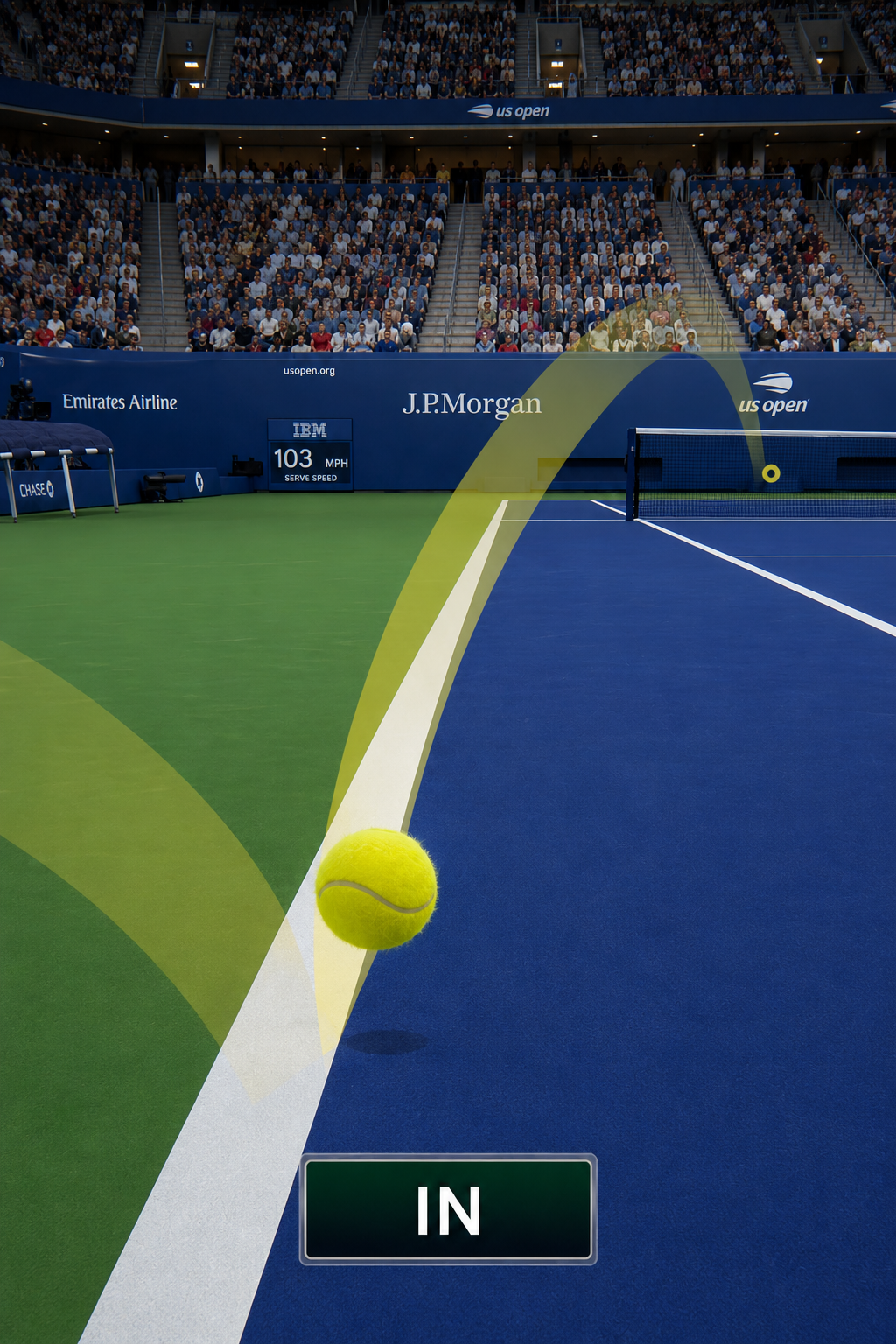
Tennis and snooker took things even further with systems like Hawk-Eye, which introduced a new level of precision to sports graphics. Hawk-Eye uses multiple high-speed cameras positioned around the venue to triangulate the exact position of a ball in real time. In tennis, it can reconstruct the ball's trajectory and determine whether a shot is in or out with millimetre accuracy. Cricket's Decision Review System uses the same technology to produce the iconic ball-tracking visualisations that show whether a delivery was pitching in line and hitting the stumps - graphics so familiar that fans now instinctively read them before the commentator has finished speaking. The genius of Hawk-Eye across all these sports is not just accuracy, but presentation. It turns raw data into clean visualisations that audiences can understand instantly, even while shouting at the TV from the patio about a questionable call.
Football took precision officiating even further with VAR - the Video Assistant Referee. Introduced at the 2018 World Cup, VAR gives a team of off-field officials access to dozens of camera feeds to review match-changing decisions in real time. From a broadcast graphics standpoint, it is as much a visual storytelling system as a refereeing tool, automatically generating animated offside lines with player limbs frozen in space that have become some of the most recognised graphics in modern sport. The 2022 World Cup in Qatar added another layer: a connected ball containing a sensor that tracked its position around 500 times per second, syncing with camera data to feed the semi-automated offside system. The Premier League rolled out its own version of that technology in April 2025, cutting average decision times significantly. The downside, as any football fan will tell you, is that VAR has introduced a new kind of broadcast drama - the extended pause while the world waits to find out if a goal will stand.
Modern sports graphics systems have evolved into fully integrated real-time engines, often built on game development technology. These systems can generate full 3D environments, virtual cameras, augmented reality overlays, and dynamic statistics that update instantly as the game unfolds. You might see virtual ads on the pitch, floating player stats, heat maps, or even replays reconstructed from multiple camera feeds as if the whole stadium is a simulation. The goal is always the same - make complex data feel effortless and entertaining. When it works well, you do not notice the technology at all, which is ironic given how much computing power is running behind every frame.
Of course, not everything is perfect in the world of broadcast graphics. Anyone who has watched enough live sport has seen the occasional glitch - a score bug that updates a second too late, a virtual line that jitters when the camera pans too fast, or a player name that briefly belongs to the wrong person entirely. These bugs are rare, but they are memorable, partly because they remind us that the polished surface of live sport is held together by very real machines, software pipelines, and human operators trying to keep everything in sync.
Today, the latest HD and UHD sports graphics systems are so advanced they are often indistinguishable from the live action itself. Integrated broadcast engines handle everything from score bugs to immersive augmented reality features that place virtual objects directly into the stadium environment. Yet at its core, the purpose has not changed since those early scoreboard cameras - to help viewers understand the game better while staying connected to the action. The difference is that now the graphics do not just support the broadcast, they are part of the show, quietly shaping how we experience every pass, shot, and goal.
In the very early days of televised sport, graphics were not graphics at all. If you wanted a score, you often got a literal second camera pointed at a physical scoreboard in the stadium. A technician would cut to it like a proud parent showing off a school project. Sometimes the scoreboard was tiny, sometimes it was off in the distance, and sometimes a gust of wind or a badly placed banner would obscure half the numbers. Announcers would read player names and scores out loud, occasionally correcting themselves mid-sentence when someone shouted an update from the production truck. It was charming, but not exactly precise. The idea of overlaying crisp digital text directly onto the broadcast was still science fiction at that point.
As technology progressed, character generators began to appear, allowing broadcasters to superimpose basic text over the live feed. These early caption systems were revolutionary, even if they looked like they were designed on a calculator from a hardware store. Suddenly you could have clean player names, scores, and time remaining without cutting away from the action. Producers could keep the camera on the field while still feeding information to viewers, which meant fewer missed plays and more immersion. Still, everything was static and a bit clunky, like a digital sticky note taped to the screen.
Then came the era of the Quantel Paintbox, which in hindsight feels like the moment sports graphics learned to paint outside the lines. This was the system that allowed designers to create more complex visual overlays, textures, and early forms of broadcast branding that felt genuinely modern. Suddenly, sports broadcasts did not just inform you, they had style. Lower thirds became more than labels, they became part of a visual identity. Graphics could be pre-rendered and layered into live feeds with a level of sophistication that made earlier broadcasts look like they were held together with glue and optimism. Today's sporting events combine these sophisticated broadcast graphics with spectacular in-stadium displays, creating an experience that looks just as impressive for the fans in the stands as it does for viewers at home. If you're interested in the giant displays that have become a fixture at modern venues, check out my guide to LED video walls.
If there is one graphics milestone that even casual viewers recognise, it is the NFL's first down line, often referred to as the '1st and 10' line. It looks simple on screen, just a glowing line across the field, but under the hood it is a remarkable mix of tracking data, camera calibration, and real-time rendering. The system maps the playing surface using multiple camera angles and field reference points, then projects a virtual line that matches the perspective of the broadcast camera exactly. It is so seamless that people often forget it is not physically on the field, which is the highest compliment any piece of broadcast tech can get. Not every experiment landed as smoothly, though. Fox's FoxTrax glowing puck, introduced for NHL broadcasts in 1996, added a comet-like blue trail to help casual viewers follow the puck on screen. Hockey purists hated it passionately, casual viewers were mildly grateful, and it was quietly retired after two seasons - a reminder that even well-intentioned graphics can overstep their welcome.
Tennis and snooker took things even further with systems like Hawk-Eye, which introduced a new level of precision to sports graphics. Hawk-Eye uses multiple high-speed cameras positioned around the venue to triangulate the exact position of a ball in real time. In tennis, it can reconstruct the ball's trajectory and determine whether a shot is in or out with millimetre accuracy. Cricket's Decision Review System uses the same technology to produce the iconic ball-tracking visualisations that show whether a delivery was pitching in line and hitting the stumps - graphics so familiar that fans now instinctively read them before the commentator has finished speaking. The genius of Hawk-Eye across all these sports is not just accuracy, but presentation. It turns raw data into clean visualisations that audiences can understand instantly, even while shouting at the TV from the patio about a questionable call.
Football took precision officiating even further with VAR - the Video Assistant Referee. Introduced at the 2018 World Cup, VAR gives a team of off-field officials access to dozens of camera feeds to review match-changing decisions in real time. From a broadcast graphics standpoint, it is as much a visual storytelling system as a refereeing tool, automatically generating animated offside lines with player limbs frozen in space that have become some of the most recognised graphics in modern sport. The 2022 World Cup in Qatar added another layer: a connected ball containing a sensor that tracked its position around 500 times per second, syncing with camera data to feed the semi-automated offside system. The Premier League rolled out its own version of that technology in April 2025, cutting average decision times significantly. The downside, as any football fan will tell you, is that VAR has introduced a new kind of broadcast drama - the extended pause while the world waits to find out if a goal will stand.
Modern sports graphics systems have evolved into fully integrated real-time engines, often built on game development technology. These systems can generate full 3D environments, virtual cameras, augmented reality overlays, and dynamic statistics that update instantly as the game unfolds. You might see virtual ads on the pitch, floating player stats, heat maps, or even replays reconstructed from multiple camera feeds as if the whole stadium is a simulation. The goal is always the same - make complex data feel effortless and entertaining. When it works well, you do not notice the technology at all, which is ironic given how much computing power is running behind every frame.
Of course, not everything is perfect in the world of broadcast graphics. Anyone who has watched enough live sport has seen the occasional glitch - a score bug that updates a second too late, a virtual line that jitters when the camera pans too fast, or a player name that briefly belongs to the wrong person entirely. These bugs are rare, but they are memorable, partly because they remind us that the polished surface of live sport is held together by very real machines, software pipelines, and human operators trying to keep everything in sync.
Today, the latest HD and UHD sports graphics systems are so advanced they are often indistinguishable from the live action itself. Integrated broadcast engines handle everything from score bugs to immersive augmented reality features that place virtual objects directly into the stadium environment. Yet at its core, the purpose has not changed since those early scoreboard cameras - to help viewers understand the game better while staying connected to the action. The difference is that now the graphics do not just support the broadcast, they are part of the show, quietly shaping how we experience every pass, shot, and goal.
You may purchase items mentioned in this article here. Affiliate links earn me a commission at no extra cost to you. Thanks for supporting IanGardner.com