Decks Appeal
From vinyl grooves to digital moves, DJ gear has come a long way. Cue up the story of how turntables, CDJs, timecode records and DDJs have kept the beat going for half a century.
Ian Gardner is a British-American broadcaster, voice artist and audio enthusiast, sharing years of experience building creative workflows from a modern home studio. He helps readers make smarter buying decisions across studio gear, production tools and home comforts for both inside and outside the workspace. Broadcasters, podcasters, voice artists, producers and digital creators will find guidance that supports high production values and efficient workflows for building a successful home studio business. Similar articles can be found in the studio-essentials blog.
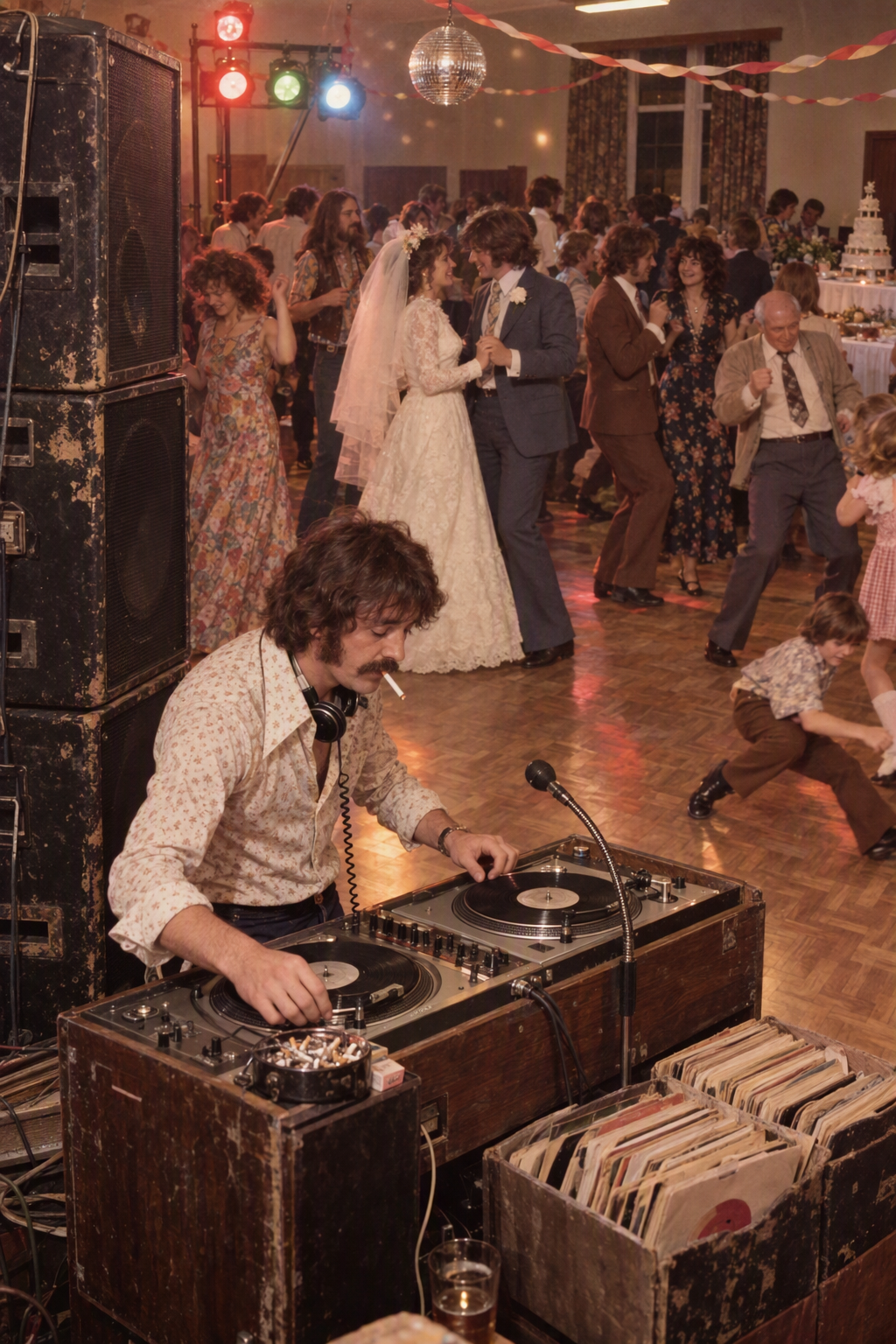
Picture a wedding reception in the mid-1970s. The DJ arrives with crates of vinyl, an amplifier that takes two people to lift and a pair of speaker cabinets roughly the size of a wardrobe. Fast forward to today and the same job can be done with a laptop, a compact controller and a USB stick that weighs less than a single 12-inch record. The road between those two scenes is one of the most entertaining stories in audio technology, driven by clever engineering and a stubborn desire to make one song flow seamlessly into the next.
Long before anyone talked about DJ equipment as a category of its own, music at dances, youth clubs and village halls was usually supplied by whoever owned a record player and a decent stack of singles. Radio presenters had been playing records on air for decades, but the travelling mobile disco really took off in the 1960s and 1970s as recorded music became a cheaper and more reliable alternative to booking a band. The setup was simple by modern standards, usually a turntable or two, a basic mixer, a separate power amplifier and some very heavy speakers. There were no screens, no waveforms and no software quietly working out the tempo, just the DJ's ears and a good memory for what was in the record box.
The records themselves were a huge part of the workload. Hundreds of 7-inch singles and 12-inch discs had to be carried, protected from scratches and organised so the right song could be found in a matter of seconds. Add microphones, lighting, cables, stands and flight cases, and setting up for a four-hour party could feel a lot like moving house. A good mobile DJ in this era was part music librarian, part roadie and part electrician.
The arrival of the 12-inch single in 1970s disco culture changed what a DJ could do with a record. The larger surface allowed wider grooves, which meant louder playback and longer running times, and record labels began releasing extended mixes with stripped-back intros and outros. Those extra bars gave DJs room to breathe instead of racing to cue the next three-minute radio edit. Just as importantly, they encouraged DJs to overlap records rather than simply stopping one and starting another.
With two turntables and a mixer, overlapping records became a craft known as beat mixing. The idea is to adjust the speed of the incoming record until its beats line up with the one already playing, so the two run together without a stumble. If one track sits at 120 beats per minute and the next at 124, the DJ nudges the pitch until they match, then keeps listening and making tiny corrections as the records drift. Done well, the dance floor never notices the join, and the night feels like one long continuous piece of music.
While disco DJs were perfecting smooth blends, hip-hop DJs in the Bronx were taking the turntable somewhere completely different. Pioneers such as DJ Kool Herc extended the instrumental breaks in funk records by switching between two copies of the same disc, and Grand Wizzard Theodore is widely credited with developing the scratch. By pushing a record back and forth under the stylus and flicking the crossfader, these DJs created rhythmic sounds that had never existed on the original recording. The turntable had stopped being a playback device and become a musical instrument in its own right.
No piece of kit is more closely tied to that history than the Technics SL-1200. Launched in 1972 as a hi-fi turntable, it found its true calling with the SL-1200MK2 in 1979, which added the smooth pitch slider DJs came to love, alongside its black sibling, the SL-1210. Its direct-drive motor sits right beneath the platter rather than turning it with a belt, giving it strong torque and almost instant start-up. That meant a DJ could hold a record still, let it go on the beat and trust it to reach full speed immediately, which is exactly what cueing and scratching demand.
The classic Technics decks are full of thoughtful details. The rows of dots around the edge of the platter are a speed check, lit by a strobe lamp so that they appear to stand still when the platter is turning at the correct speed. The pitch slider offers roughly eight percent of adjustment either way, raising or lowering both tempo and musical key together. At the end of the tonearm sits the cartridge and its tiny diamond stylus, which turns the wiggles in the groove into a small electrical signal, and a worn stylus can quietly chew through a precious record collection if it is not replaced in time.
The compact disc began to change the picture in the late 1980s and 1990s. Ordinary CD players were never designed for DJs, but manufacturers soon produced dedicated models with pitch control, cue buttons and eventually jog wheels that imitated the feel of a record. Pioneer's CDJ-500, introduced in 1994, helped set the template for the club CD players that would dominate DJ booths for years. Suddenly a DJ could carry a wallet of discs instead of a crate of vinyl, and the music no longer wore out a little more with every play.
CD decks were not an instant hit with everyone. Many DJs found that buttons and jog wheels felt less natural than a spinning record, and early machines varied in how accurately they handled pitch and timing. Twin-deck units were often bulky, and the best club models were expensive. Even so, the core skill of matching two tracks by ear carried over intact, and a new generation of DJs grew up mixing on discs rather than vinyl.
The next leap came when music stopped being a physical object at all. MP3 compression made audio files small enough to store thousands of songs on a computer, and the iPod, launched in 2001, showed the world that an entire record collection could live in a pocket. An iPod was not a serious DJ tool, but laptops and external hard drives quickly became one. A working DJ's library could now be searched by artist, title, genre or tempo in seconds.
For DJs who still loved the feel of vinyl, digital vinyl systems offered a clever compromise. Products such as Final Scratch, released in 2001, and later Serato Scratch Live used special timecode records that sent a control signal to a computer instead of music. The software read how the record was moving and played the digital file to match, scratches and all. Turntablists could keep their technique while leaving their irreplaceable records safely at home.
Digital libraries solved old problems and created new ones. Organising thousands of files, tagging them properly and preparing cue points in advance became a job in itself. Losing a laptop or a USB stick could wipe out an entire night's music, whereas forgetting a single record only meant one missing song. Backups suddenly mattered just as much to DJs as they do to anyone running a home studio.
The modern DJ controller brings almost the whole booth together in a single box. Ranges such as Pioneer DJ's DDJ series connect to a laptop over USB and work with software like rekordbox or Serato DJ, with the software handling the music and the controller providing the hands-on control. Jog wheels echo the feel of a turntable, channel faders and a crossfader handle the blend, and EQ knobs shape the bass, mids and treble of each track. Rows of performance pads can fire cue points, loops, samples and effects, turning the controller into a compact live production tool.
Those pads will feel very familiar to anyone from a radio background. A DJ can load drops such as a name ident, a sound effect or a short musical sting and fire them over a mix with perfect timing. Loops can stretch a favourite section, echo and filter effects can smooth a tricky transition, and short passages can be sampled on the fly. It is the same instinct as firing jingles and stabs from a broadcast desk, just set to a beat.
Many controllers also include a built-in audio interface, with outputs for speakers and inputs for a microphone and headphones. Some can work without a laptop, playing music directly from a USB drive, while larger club systems take that idea even further. Connections and software compatibility vary a lot between models, so it is always worth checking the specifications before buying. The difference in size compared with the old mobile rig is remarkable, although you still need a decent pair of speakers or a PA system for anyone to hear the results.
Modern software has also raised a question that sparks endless debate among DJs. Programs can now analyse each track, estimate its tempo, display scrolling waveforms and lock two songs together with a single press of the sync button. Some argue that this has taken the skill out of mixing, while others see it as freeing DJs to focus on creativity. The truth probably sits somewhere in between.
Sync is excellent at matching tempo, but it cannot choose the right song for the moment. Software can misread tracks with live drumming, shifting tempos or unusual rhythms, and a DJ who can only mix with the screen will be stuck when that happens. Two perfectly synchronised tracks can still clash horribly if their keys, phrasing or energy do not suit each other. Reading a room, building a set and knowing when to bring the next song in remain entirely human skills.
Learning to beat match by ear is still well worth the effort, even if you rarely need it. It sharpens your listening, tightens your sense of timing and teaches you a great deal about how music is put together. For a home studio owner, a modern controller is an affordable way to explore all of this without a dedicated room or a vintage turntable budget. The same instincts that help when editing a podcast or building a jingle come straight into play when blending two tracks live.
From crates of vinyl and back-breaking amplifiers to a lightweight controller and a laptop, DJ equipment has changed almost beyond recognition. Music has become more portable, more affordable and far easier to manipulate than the early mobile DJs could ever have imagined. Yet the heart of the job has stayed exactly the same, which is taking two pieces of music and joining them so well that the result is more exciting than either one alone. If the dance floor never notices where one song ends and the next begins, you are carrying on a tradition that stretches right back to that 1970s wedding reception.
You may purchase items mentioned in this article here. Affiliate links earn me a commission at no extra cost to you. Thanks for supporting IanGardner.com