Why MIDI Matters
Before MIDI, electronic instruments were brilliant but stubborn. Discover how one shared language changed music production forever and remains the most flexible way to control sound using a computer.
Ian Gardner is a British-American broadcaster, voice artist and audio enthusiast, sharing years of experience building creative workflows from a modern home studio. He helps readers make smarter buying decisions across studio gear, production tools and home comforts for both inside and outside the workspace. Broadcasters, podcasters, voice artists, producers and digital creators will find guidance that supports high production values and efficient workflows for building a successful home studio business. Similar articles can be found in the computers blog.
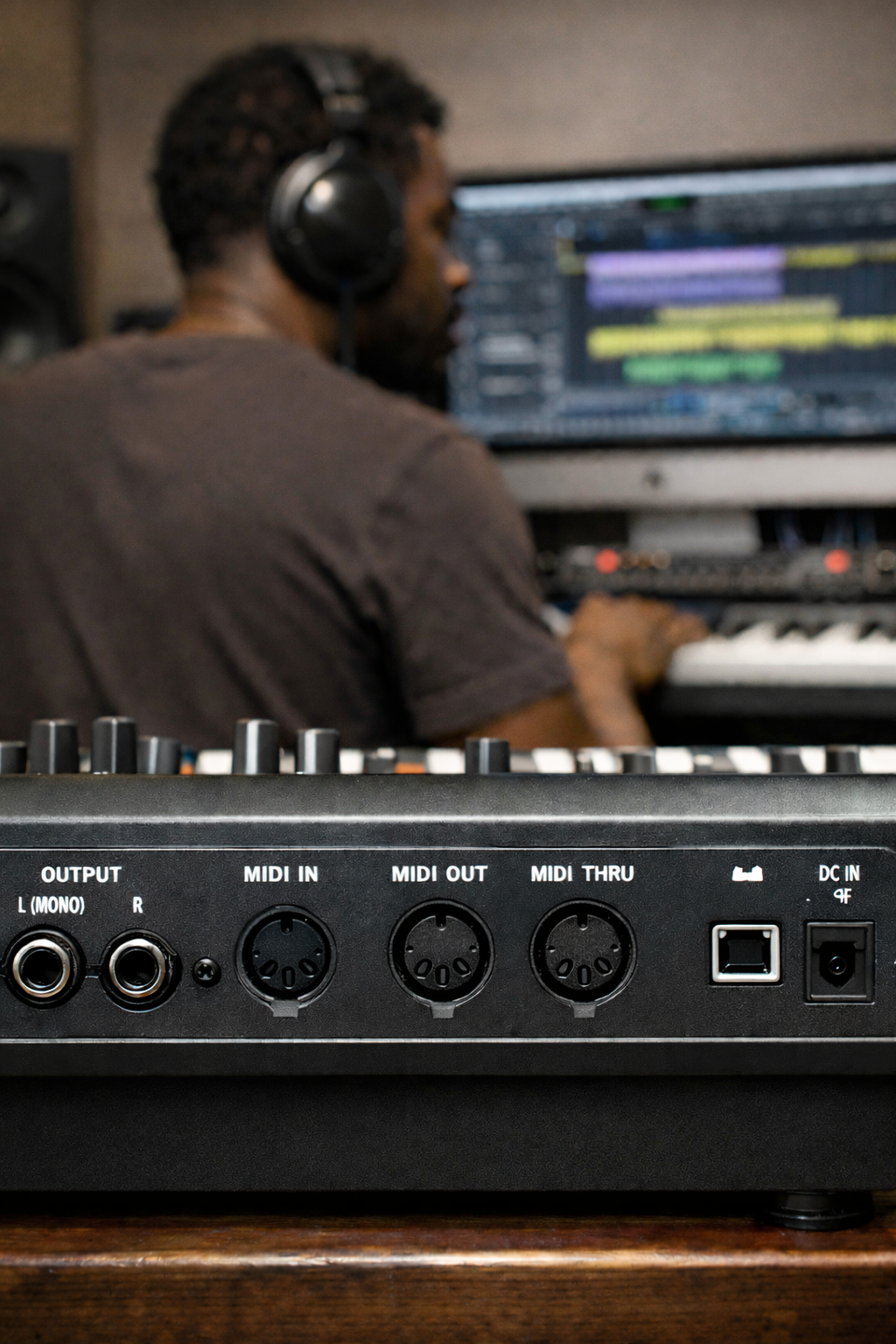
MIDI is one of those technologies that quietly runs the music world while rarely asking for attention. It does not make sound, it does not add warmth, and it does not have a vintage smell. Yet without MIDI, modern music production would feel like trying to run a studio with walkie-talkies and handwritten notes. To understand why MIDI matters, it helps to rewind to a time when electronic instruments were impressive but stubbornly antisocial.
In the late 1970s and early 1980s, synthesisers were booming. Every manufacturer had their own idea of how a keyboard should behave, how notes should be triggered, and how parameters should be controlled. The problem was that none of them spoke the same language. If you owned a Roland synth and a Sequential Circuits synth, they could sit side by side like awkward strangers at a party, refusing to communicate. Musicians wanted layers, control, and synchronisation, but the technology simply was not cooperating.
This is where MIDI was born. In 1983, several manufacturers including Roland, Yamaha, Korg, and Sequential Circuits agreed on a shared standard called Musical Instrument Digital Interface. The goal was simple but ambitious - create a universal language that allowed electronic instruments to talk to each other. Not audio, just instructions. Think less sound waves and more sheet music translated into numbers.
That distinction is crucial. MIDI does not carry sound. It carries data. When you press a key on a MIDI keyboard, it sends a message saying which note was pressed, how hard it was hit, and when it was released. That message can travel to another instrument, a rack module, or eventually a computer. The receiving device then decides how that instruction should sound. One note, endless possibilities.
Early MIDI connections used the familiar 5-pin DIN cable. If you have ever seen one, it looks like something rescued from the back of a hi-fi cabinet. Despite its retro appearance, it was clever. MIDI data travels in one direction at a time, which is why devices have MIDI In, MIDI Out, and MIDI Thru ports. It sounds clunky, but it worked beautifully and reliably, which is why those ports are still found on modern gear.
Once MIDI existed, everything changed quickly. Suddenly one keyboard could control several synths at once. Drum machines could stay in perfect time. Sequencers could record performances not as audio, but as editable data. Play a wrong note? Change it later. Play too softly? Increase the velocity. MIDI gave musicians the power to revise history.
As computers became more powerful, MIDI found a natural home. Early music software like Cubase and Logic were built around MIDI sequencing long before audio recording was practical on home machines. A computer could act as the brain of a studio, sending MIDI instructions to synths, samplers, and drum machines while keeping everything locked to a tempo. The computer did not care how many times you rewrote a chorus.
At its core, MIDI works using channels and messages. There are 16 MIDI channels, which means one cable can control up to 16 different instruments independently. Messages include note on, note off, velocity, pitch bend, modulation, and control change. Control change messages are where MIDI becomes truly expressive. A single knob can be mapped to filter cutoff, resonance, volume, or any parameter you can imagine. Twist the knob, send the data, shape the sound.
In a home studio today, MIDI is everywhere, even if it is invisible. USB largely replaced traditional MIDI cables, but the data is the same. Plug in a MIDI keyboard and your computer recognises it instantly. Play a note and your software instrument responds. Record that performance and it becomes a MIDI clip you can edit endlessly. Change the instrument, change the tempo, change the key, all without re-recording.
This flexibility is why MIDI remains essential. Audio is final. MIDI is forgiving. You can record a piano part at 3am, realise it should be a synth pad at 3pm, and switch it with a click. MIDI lets ideas stay fluid for longer, which is a gift to creativity and a curse to decision-making.
MIDI also shines when connecting hardware. A modern home studio might include a controller keyboard, a hardware synth, a drum machine, and a computer. MIDI allows them to work together as one system. The computer can send clock information so everything stays in time. One keyboard can play everything. Automation can move real knobs on real gear, blurring the line between digital and physical.
Despite its age, MIDI has evolved. MIDI 2.0 promises higher resolution, better expression, and more detailed control. Yet the original MIDI spec from the 1980s is still fully usable today. That is a rare achievement in technology, and a reminder that good ideas last.
So MIDI is not flashy, and it does not make a sound on its own. What it does is enable connection, control, and collaboration between instruments and computers. It is the quiet translator that makes modern music possible. Once you understand it, MIDI stops feeling technical and starts feeling like freedom.
In the late 1970s and early 1980s, synthesisers were booming. Every manufacturer had their own idea of how a keyboard should behave, how notes should be triggered, and how parameters should be controlled. The problem was that none of them spoke the same language. If you owned a Roland synth and a Sequential Circuits synth, they could sit side by side like awkward strangers at a party, refusing to communicate. Musicians wanted layers, control, and synchronisation, but the technology simply was not cooperating.
This is where MIDI was born. In 1983, several manufacturers including Roland, Yamaha, Korg, and Sequential Circuits agreed on a shared standard called Musical Instrument Digital Interface. The goal was simple but ambitious - create a universal language that allowed electronic instruments to talk to each other. Not audio, just instructions. Think less sound waves and more sheet music translated into numbers.
That distinction is crucial. MIDI does not carry sound. It carries data. When you press a key on a MIDI keyboard, it sends a message saying which note was pressed, how hard it was hit, and when it was released. That message can travel to another instrument, a rack module, or eventually a computer. The receiving device then decides how that instruction should sound. One note, endless possibilities.
Early MIDI connections used the familiar 5-pin DIN cable. If you have ever seen one, it looks like something rescued from the back of a hi-fi cabinet. Despite its retro appearance, it was clever. MIDI data travels in one direction at a time, which is why devices have MIDI In, MIDI Out, and MIDI Thru ports. It sounds clunky, but it worked beautifully and reliably, which is why those ports are still found on modern gear.
Once MIDI existed, everything changed quickly. Suddenly one keyboard could control several synths at once. Drum machines could stay in perfect time. Sequencers could record performances not as audio, but as editable data. Play a wrong note? Change it later. Play too softly? Increase the velocity. MIDI gave musicians the power to revise history.
As computers became more powerful, MIDI found a natural home. Early music software like Cubase and Logic were built around MIDI sequencing long before audio recording was practical on home machines. A computer could act as the brain of a studio, sending MIDI instructions to synths, samplers, and drum machines while keeping everything locked to a tempo. The computer did not care how many times you rewrote a chorus.
At its core, MIDI works using channels and messages. There are 16 MIDI channels, which means one cable can control up to 16 different instruments independently. Messages include note on, note off, velocity, pitch bend, modulation, and control change. Control change messages are where MIDI becomes truly expressive. A single knob can be mapped to filter cutoff, resonance, volume, or any parameter you can imagine. Twist the knob, send the data, shape the sound.
In a home studio today, MIDI is everywhere, even if it is invisible. USB largely replaced traditional MIDI cables, but the data is the same. Plug in a MIDI keyboard and your computer recognises it instantly. Play a note and your software instrument responds. Record that performance and it becomes a MIDI clip you can edit endlessly. Change the instrument, change the tempo, change the key, all without re-recording.
This flexibility is why MIDI remains essential. Audio is final. MIDI is forgiving. You can record a piano part at 3am, realise it should be a synth pad at 3pm, and switch it with a click. MIDI lets ideas stay fluid for longer, which is a gift to creativity and a curse to decision-making.
MIDI also shines when connecting hardware. A modern home studio might include a controller keyboard, a hardware synth, a drum machine, and a computer. MIDI allows them to work together as one system. The computer can send clock information so everything stays in time. One keyboard can play everything. Automation can move real knobs on real gear, blurring the line between digital and physical.
Despite its age, MIDI has evolved. MIDI 2.0 promises higher resolution, better expression, and more detailed control. Yet the original MIDI spec from the 1980s is still fully usable today. That is a rare achievement in technology, and a reminder that good ideas last.
So MIDI is not flashy, and it does not make a sound on its own. What it does is enable connection, control, and collaboration between instruments and computers. It is the quiet translator that makes modern music possible. Once you understand it, MIDI stops feeling technical and starts feeling like freedom.
You may purchase items mentioned in this article here. Affiliate links earn me a commission at no extra cost to you. Thanks for supporting IanGardner.com