Decoding Scannable Codes
From barcodes to QR codes, scanning has become one of the most effortless ways to access information. What started as a method of identifying products has evolved into a universal language read instantly by your smartphone.
Ian Gardner is a British-American broadcaster, voice artist and audio enthusiast, sharing years of experience building creative workflows from a modern home studio. He helps readers make smarter buying decisions across studio gear, production tools and home comforts for both inside and outside the workspace. Broadcasters, podcasters, voice artists, producers and digital creators will find guidance that supports high production values and efficient workflows for building a successful home studio business. Similar articles can be found in the studio-essentials blog.
Barcodes are one of those bits of technology we barely notice until they stop working. Suddenly you're standing in a supermarket queue while someone types in twelve digits by hand and everyone behind you begins reconsidering their life choices. Yet that humble arrangement of black lines changed retail forever, and without it, the modern QR code simply wouldn't exist.
The story begins in the 1940s, when retailers wanted a faster way to price groceries. Manual pricing was slow, error-prone, and about as exciting as watching paint dry. In 1948, a graduate student named Bernard Silver overheard a supermarket executive asking whether product information could somehow be read automatically at checkout. Silver mentioned the problem to his friend Norman Joseph Woodland, and together they set about solving it.
Woodland's first idea was inspired by Morse code. He drew dots and dashes in the sand, then stretched them vertically into lines. It was simple, elegant, and, most importantly, machine-readable. The first barcode patent was granted in 1952, though practical implementation took a little longer. Computers were still enormous, lasers were cutting-edge, and most supermarkets were not yet keen to install what looked suspiciously like equipment from a science fiction film. Everything changed in the 1970s with the arrival of the Universal Product Code, better known as the UPC. The first item ever scanned was a packet of Wrigley's chewing gum in 1974. That single beep launched a retail revolution. Suddenly, stock control, pricing, and checkout speeds improved dramatically. Every supermarket aisle became a data network disguised as a snack display.
Technically speaking, traditional barcodes are one-dimensional. They store data horizontally using varying widths of black bars and white spaces. A laser scanner shines a red beam across the code, and a photodiode measures the reflected light. Black bars absorb light, white spaces reflect it, and software translates the pattern into numbers. It's wonderfully clever for something you can print on a cereal box.
For home studio enthusiasts, it's not entirely unlike reading audio from vinyl. The scanner detects variations, converts them into electrical signals, and software interprets the result. One is shopping, the other is music, but both rely on precise analog-to-digital translation. Technology loves patterns. The limitation of one-dimensional barcodes is capacity. They can only hold a relatively small amount of information. A product number is fine, but you wouldn't want to encode your life story, or even your average guitar pedal settings.
That problem led to two-dimensional codes. In 1994, the Japanese company Denso Wave developed the Quick Response code, or QR code, for tracking automotive components during manufacturing. Assembly lines move quickly, and engineers wanted a code that could be scanned instantly from any angle. Hence the name. QR codes are essentially barcodes that went to university. Instead of a single line of data, they store information both horizontally and vertically. Those three large squares in the corners help scanners determine orientation instantly. Whether the code is upside down, sideways, or stuck awkwardly on a curved surface, it can still be read.
This is where things get particularly impressive. QR codes use Reed-Solomon error correction, allowing them to remain readable even when partially damaged. Depending on the correction level, up to around 30 percent of the code can be obscured and still function perfectly. It's the coding equivalent of understanding a singer despite a noisy pub audience and a slightly questionable PA system.
That resilience is one reason QR codes exploded in popularity. Another is that modern smartphone cameras do all the hard work automatically. Your phone captures the image, identifies the finder patterns, corrects perspective distortion, applies error correction, decodes the binary data, and presents the result in a fraction of a second. It's an extraordinary amount of computing power used mostly to access restaurant menus.
And access menus we do. QR codes are everywhere. Restaurant tables, airline boarding passes, concert tickets, parcel tracking labels, museum exhibits, product packaging, Wi-Fi logins, contactless payments, authentication systems, and enough coffee shop loyalty schemes to fill several hard drives.
Musicians encounter them too. Album sleeves can link to bonus tracks. Equipment manuals often include QR codes for video tutorials. Trade show badges use them for lead capture. Even some synthesizers now hide setup guides behind a neatly printed square. The humble QR code has become the Swiss Army knife of digital access.
There are plenty of barcode varieties as well. Code 39, Code 128, EAN, ISBN, Data Matrix, PDF417 - each designed for specific industries and data requirements. Airlines love PDF417. Manufacturers often prefer Data Matrix. Retailers stick largely with UPC and EAN. It's a bit like audio formats - WAV, FLAC, MP3, AIFF. Same broad purpose, different strengths.
The pandemic accelerated QR adoption dramatically. Suddenly, nobody wanted to touch anything unless absolutely necessary. Menus vanished. Payment terminals became optional. Even sharing contact details could be handled with a quick scan. QR codes went from niche utility to everyday habit almost overnight.
Their beauty lies in simplicity. They're cheap to generate, easy to print, and universally accessible. No specialist hardware required. Just a camera phone and a tiny bit of curiosity.
Which brings us neatly to weddings.
In my work creating personalized wedding songs for couples, one question comes up time and time again - once the first dance is over and the happy tears have been strategically wiped away, how do you share that song with everyone else? Emailing MP3 files feels rather like sending someone a fax to announce your new streaming service. Download links get buried, attachments mysteriously vanish, and there is always at least one relative who cannot locate the file despite having successfully navigated international air travel. Couples want something instant, elegant, and memorable - a way for every guest to hear and keep their song without technical gymnastics. That's exactly where QR codes step onto the dance floor.
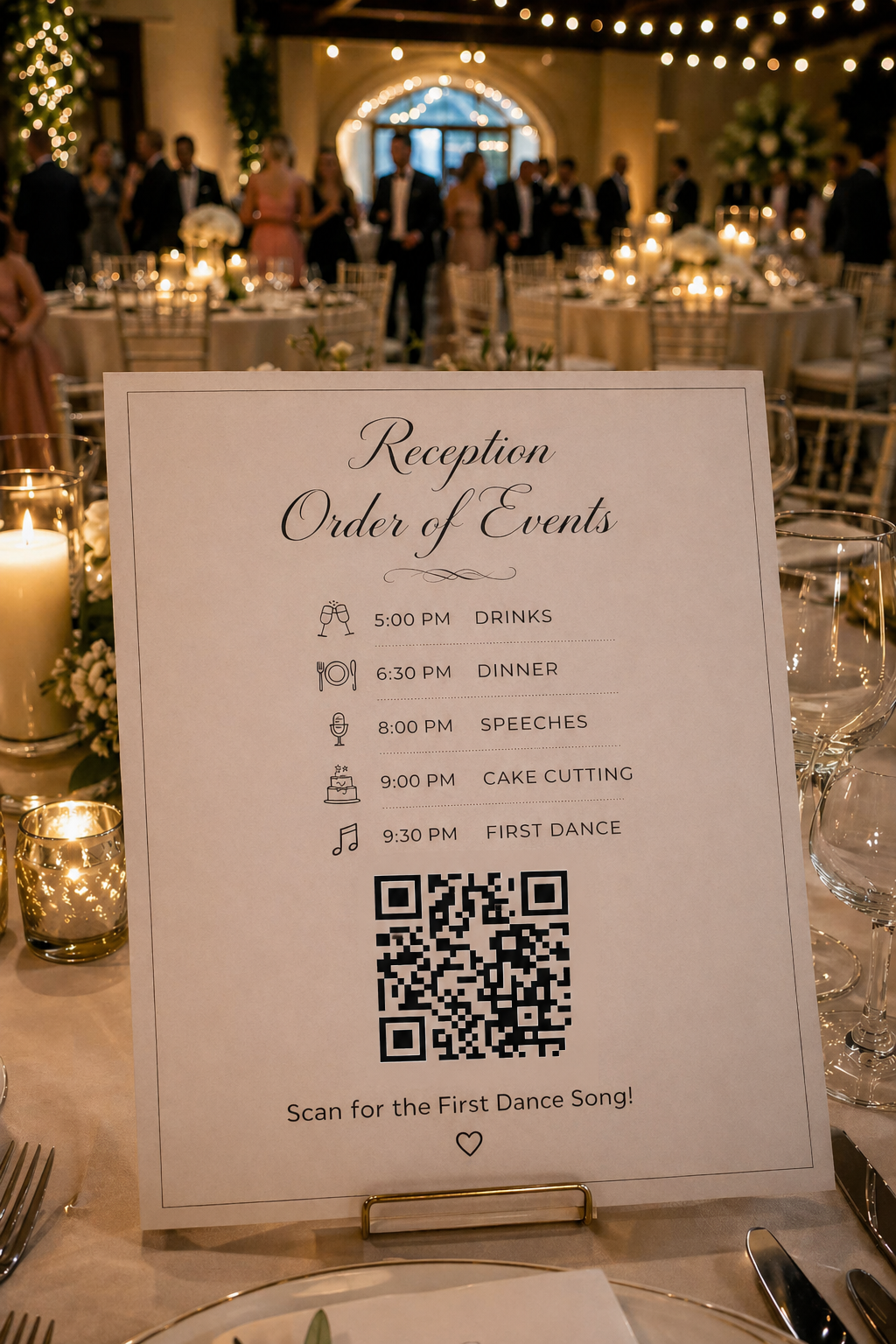
Imagine guests arriving to find a beautifully designed QR code printed on invitations, table cards, the order of service, or perhaps revealed by the DJ on a large screen after the first dance. A quick scan could unlock something extraordinary - a professionally crafted, deeply personal wedding song created exclusively for the couple. Every guest can instantly hear the same emotional moment, wherever they are, directly from their own phone.
Better still, the link can remain hidden until exactly the right moment. The code is there all along, teasing its purpose, but only activates after the couple's first dance. No spoilers, no premature scanning, just perfect timing. It's a modern twist that combines technology, music, and shared experience in a way traditional wedding favours simply can't match.
A custom wedding song distributed by QR code becomes more than just a performance. It becomes a keepsake, a conversation piece, and a memory every guest can take home in their pocket. That's the real magic - not the code itself, but where it leads. And if you want to hear a real wedding song called This Dance is Different just scan the QR code in the article picture!
The story begins in the 1940s, when retailers wanted a faster way to price groceries. Manual pricing was slow, error-prone, and about as exciting as watching paint dry. In 1948, a graduate student named Bernard Silver overheard a supermarket executive asking whether product information could somehow be read automatically at checkout. Silver mentioned the problem to his friend Norman Joseph Woodland, and together they set about solving it.
Woodland's first idea was inspired by Morse code. He drew dots and dashes in the sand, then stretched them vertically into lines. It was simple, elegant, and, most importantly, machine-readable. The first barcode patent was granted in 1952, though practical implementation took a little longer. Computers were still enormous, lasers were cutting-edge, and most supermarkets were not yet keen to install what looked suspiciously like equipment from a science fiction film. Everything changed in the 1970s with the arrival of the Universal Product Code, better known as the UPC. The first item ever scanned was a packet of Wrigley's chewing gum in 1974. That single beep launched a retail revolution. Suddenly, stock control, pricing, and checkout speeds improved dramatically. Every supermarket aisle became a data network disguised as a snack display.
Technically speaking, traditional barcodes are one-dimensional. They store data horizontally using varying widths of black bars and white spaces. A laser scanner shines a red beam across the code, and a photodiode measures the reflected light. Black bars absorb light, white spaces reflect it, and software translates the pattern into numbers. It's wonderfully clever for something you can print on a cereal box.
For home studio enthusiasts, it's not entirely unlike reading audio from vinyl. The scanner detects variations, converts them into electrical signals, and software interprets the result. One is shopping, the other is music, but both rely on precise analog-to-digital translation. Technology loves patterns. The limitation of one-dimensional barcodes is capacity. They can only hold a relatively small amount of information. A product number is fine, but you wouldn't want to encode your life story, or even your average guitar pedal settings.
That problem led to two-dimensional codes. In 1994, the Japanese company Denso Wave developed the Quick Response code, or QR code, for tracking automotive components during manufacturing. Assembly lines move quickly, and engineers wanted a code that could be scanned instantly from any angle. Hence the name. QR codes are essentially barcodes that went to university. Instead of a single line of data, they store information both horizontally and vertically. Those three large squares in the corners help scanners determine orientation instantly. Whether the code is upside down, sideways, or stuck awkwardly on a curved surface, it can still be read.
This is where things get particularly impressive. QR codes use Reed-Solomon error correction, allowing them to remain readable even when partially damaged. Depending on the correction level, up to around 30 percent of the code can be obscured and still function perfectly. It's the coding equivalent of understanding a singer despite a noisy pub audience and a slightly questionable PA system.
That resilience is one reason QR codes exploded in popularity. Another is that modern smartphone cameras do all the hard work automatically. Your phone captures the image, identifies the finder patterns, corrects perspective distortion, applies error correction, decodes the binary data, and presents the result in a fraction of a second. It's an extraordinary amount of computing power used mostly to access restaurant menus.
And access menus we do. QR codes are everywhere. Restaurant tables, airline boarding passes, concert tickets, parcel tracking labels, museum exhibits, product packaging, Wi-Fi logins, contactless payments, authentication systems, and enough coffee shop loyalty schemes to fill several hard drives.
Musicians encounter them too. Album sleeves can link to bonus tracks. Equipment manuals often include QR codes for video tutorials. Trade show badges use them for lead capture. Even some synthesizers now hide setup guides behind a neatly printed square. The humble QR code has become the Swiss Army knife of digital access.
There are plenty of barcode varieties as well. Code 39, Code 128, EAN, ISBN, Data Matrix, PDF417 - each designed for specific industries and data requirements. Airlines love PDF417. Manufacturers often prefer Data Matrix. Retailers stick largely with UPC and EAN. It's a bit like audio formats - WAV, FLAC, MP3, AIFF. Same broad purpose, different strengths.
The pandemic accelerated QR adoption dramatically. Suddenly, nobody wanted to touch anything unless absolutely necessary. Menus vanished. Payment terminals became optional. Even sharing contact details could be handled with a quick scan. QR codes went from niche utility to everyday habit almost overnight.
Their beauty lies in simplicity. They're cheap to generate, easy to print, and universally accessible. No specialist hardware required. Just a camera phone and a tiny bit of curiosity.
Which brings us neatly to weddings.
In my work creating personalized wedding songs for couples, one question comes up time and time again - once the first dance is over and the happy tears have been strategically wiped away, how do you share that song with everyone else? Emailing MP3 files feels rather like sending someone a fax to announce your new streaming service. Download links get buried, attachments mysteriously vanish, and there is always at least one relative who cannot locate the file despite having successfully navigated international air travel. Couples want something instant, elegant, and memorable - a way for every guest to hear and keep their song without technical gymnastics. That's exactly where QR codes step onto the dance floor.
Imagine guests arriving to find a beautifully designed QR code printed on invitations, table cards, the order of service, or perhaps revealed by the DJ on a large screen after the first dance. A quick scan could unlock something extraordinary - a professionally crafted, deeply personal wedding song created exclusively for the couple. Every guest can instantly hear the same emotional moment, wherever they are, directly from their own phone.
Better still, the link can remain hidden until exactly the right moment. The code is there all along, teasing its purpose, but only activates after the couple's first dance. No spoilers, no premature scanning, just perfect timing. It's a modern twist that combines technology, music, and shared experience in a way traditional wedding favours simply can't match.
A custom wedding song distributed by QR code becomes more than just a performance. It becomes a keepsake, a conversation piece, and a memory every guest can take home in their pocket. That's the real magic - not the code itself, but where it leads. And if you want to hear a real wedding song called This Dance is Different just scan the QR code in the article picture!
You may purchase items mentioned in this article here. Affiliate links earn me a commission at no extra cost to you. Thanks for supporting IanGardner.com