Canada Goes for Godin
The Canadian-built Godin guitar is quietly becoming a serious alternative to Fender and Gibson for players who want pro-level tone without premium pricing.
Ian Gardner is a British-American broadcaster, voice artist and audio enthusiast, sharing years of experience building creative workflows from a modern home studio. He helps readers make smarter buying decisions across studio gear, production tools and home comforts for both inside and outside the workspace. Broadcasters, podcasters, voice artists, producers and digital creators will find guidance that supports high production values and efficient workflows for building a successful home studio business. Similar articles can be found in the studio-essentials blog.
If you walk into almost any music store or scroll through guitar discussions online, the same two names tend to appear again and again. Fender and Gibson. Stratocaster, Telecaster, Les Paul. They are the reference points, the shorthand for what an electric guitar is supposed to be in the modern imagination. That influence is real and deeply rooted in music history, but it also shapes expectations in a way that does not always match how people actually make music today.
In the world of home recording, those expectations start to shift. Most musicians are not working in large commercial studios with engineers and assistants. They are working in spare rooms, basements, and improvised setups where the goal is not mythology, but output. In that environment, the question changes. It is no longer just about what a guitar represents. It becomes about how reliably it performs when there is no one else to fix problems for you.
That is where the conversation quietly expands beyond the usual Fender and Gibson framework. In practical recording situations, instruments that behave consistently tend to matter more than instruments with cultural weight. A guitar that stays in tune, records cleanly, and responds predictably to different playing dynamics can make a bigger difference to workflow than a more famous name on the headstock.
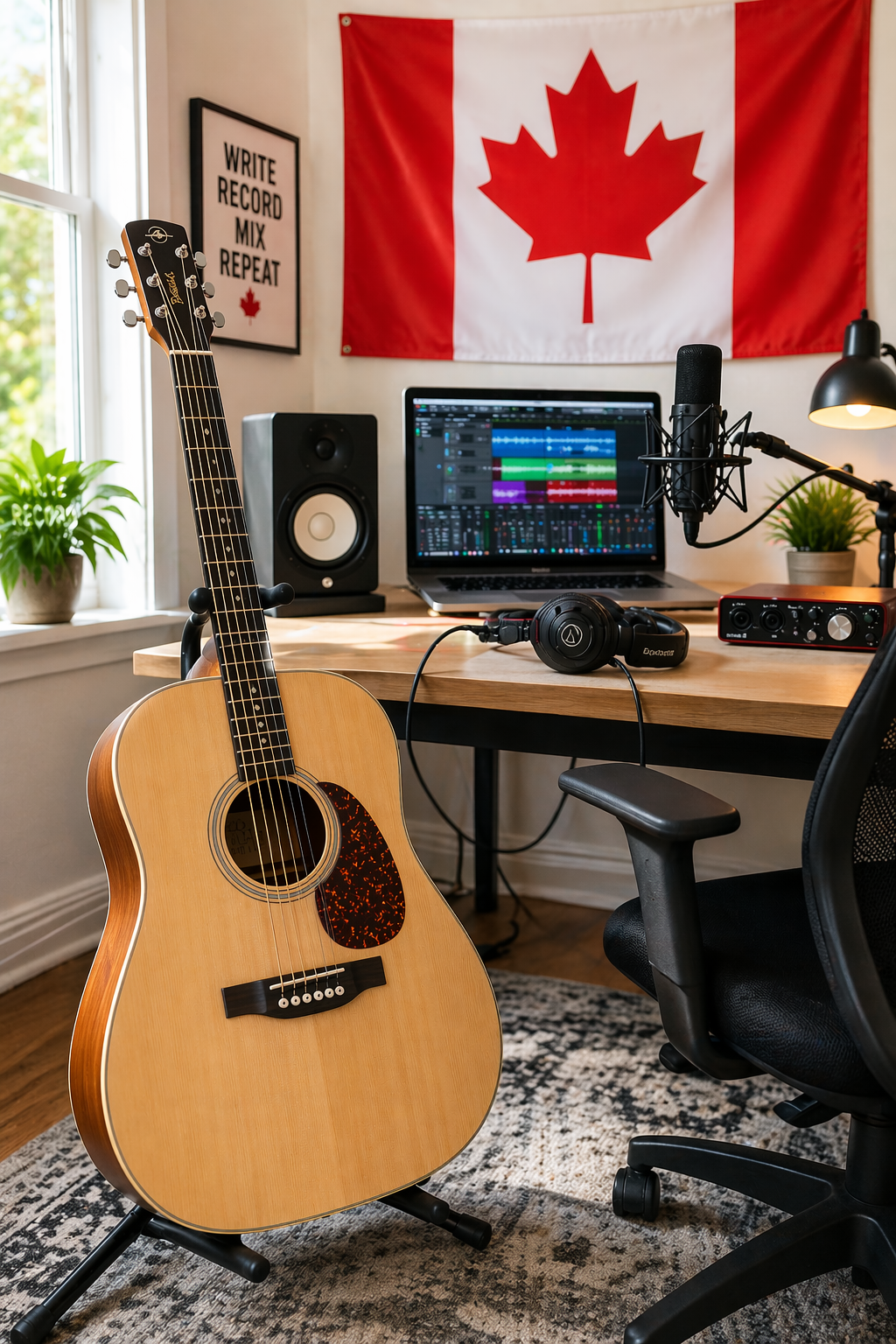
One of the most overlooked contributors to that shift comes from Canada. The Canadian guitar landscape is not defined by spectacle or celebrity endorsement. Instead, it is built around a smaller group of manufacturers focused on consistency and usability. At the center of that ecosystem is Godin, along with related brands such as Seagull, which have developed a strong reputation among working musicians and recording-focused players.
Godin's story begins in Quebec in the early 1970s, when Robert Godin started building guitars with a simple philosophy. The goal was not to compete with the image-driven side of the industry, but to create instruments that work well in real conditions. Over time, that approach expanded into a broader network of Canadian-built brands that includes Seagull, Norman, and Art & Lutherie, each with a slightly different focus but a shared emphasis on function and reliability.
Seagull in particular has become known for its acoustic guitars built in Canada. These instruments are not positioned as luxury items or stage symbols. Instead, they are designed for affordability, structural stability, and tonal balance. That design direction makes them especially relevant in recording environments, where small inconsistencies in tone or tuning stability can become exaggerated once microphones are involved.
Acoustic guitars are often more revealing than players expect. In a recording context, even minor variations in build quality or setup can introduce issues that are not obvious during casual playing. A slightly uneven frequency response or unstable tuning can turn a simple recording session into a process of correction rather than creation. Instruments that minimize those variables naturally become more valuable in that environment.
This is where the Canadian-built approach becomes particularly relevant. Godin and Seagull instruments tend to prioritize consistency across models and production runs. That means fewer surprises when switching between instruments of the same type and a more predictable response when recording. For musicians working alone, without technical support, that predictability can streamline the entire creative process.
There is also a broader contrast at play between cultural identity and practical design. Fender and Gibson are deeply embedded in the mythology of electric guitar culture. They are tied to decades of iconic recordings, legendary performers, and stylistic movements that define entire genres. Godin and Seagull operate in a different space. Their identity is less about image and more about utility, which makes them more aligned with how many modern recordings are actually produced.
It is easy to underestimate how much modern music starts with simple, functional decisions rather than artistic mythology. A large portion of recorded music begins with a basic guitar part captured in a non-ideal environment. That initial recording becomes the foundation for everything that follows. If that foundation is unstable, every additional layer of production becomes more complicated. In that sense, instrument reliability is not a minor detail. It is a structural advantage.
There is also a quiet irony in how musicians often approach their setups. Consider how much attention is given to microphones, audio interfaces, plugins, and monitoring systems, while the instrument itself is sometimes assumed to be a solved problem. In practice, the guitar can have a more immediate impact on the quality of a recording than many downstream tools. When players discover that difference, brands like Godin and Seagull tend to become much more relevant very quickly.
The broader picture is not about replacing Fender or Gibson in the conversation. Their influence is foundational and unlikely to change. Instead, it is about expanding the frame of reference. Alongside the iconic instruments that define guitar history, there is a parallel category of Canadian-made guitars designed for consistency, affordability, and recording practicality. These instruments are not trying to compete with mythology. They are focused on helping musicians get from idea to finished recording with fewer obstacles in between.
When viewed from that perspective, the role of Canadian guitar manufacturing becomes clearer. It is not positioned as an alternative to history, but as a complement to modern workflow. Godin and Seagull represent a design philosophy that prioritizes function over image, and stability over spectacle. For musicians working in real-world recording environments, that approach often turns out to be exactly what is needed.
In the world of home recording, those expectations start to shift. Most musicians are not working in large commercial studios with engineers and assistants. They are working in spare rooms, basements, and improvised setups where the goal is not mythology, but output. In that environment, the question changes. It is no longer just about what a guitar represents. It becomes about how reliably it performs when there is no one else to fix problems for you.
That is where the conversation quietly expands beyond the usual Fender and Gibson framework. In practical recording situations, instruments that behave consistently tend to matter more than instruments with cultural weight. A guitar that stays in tune, records cleanly, and responds predictably to different playing dynamics can make a bigger difference to workflow than a more famous name on the headstock.
One of the most overlooked contributors to that shift comes from Canada. The Canadian guitar landscape is not defined by spectacle or celebrity endorsement. Instead, it is built around a smaller group of manufacturers focused on consistency and usability. At the center of that ecosystem is Godin, along with related brands such as Seagull, which have developed a strong reputation among working musicians and recording-focused players.
Godin's story begins in Quebec in the early 1970s, when Robert Godin started building guitars with a simple philosophy. The goal was not to compete with the image-driven side of the industry, but to create instruments that work well in real conditions. Over time, that approach expanded into a broader network of Canadian-built brands that includes Seagull, Norman, and Art & Lutherie, each with a slightly different focus but a shared emphasis on function and reliability.
Seagull in particular has become known for its acoustic guitars built in Canada. These instruments are not positioned as luxury items or stage symbols. Instead, they are designed for affordability, structural stability, and tonal balance. That design direction makes them especially relevant in recording environments, where small inconsistencies in tone or tuning stability can become exaggerated once microphones are involved.
Acoustic guitars are often more revealing than players expect. In a recording context, even minor variations in build quality or setup can introduce issues that are not obvious during casual playing. A slightly uneven frequency response or unstable tuning can turn a simple recording session into a process of correction rather than creation. Instruments that minimize those variables naturally become more valuable in that environment.
This is where the Canadian-built approach becomes particularly relevant. Godin and Seagull instruments tend to prioritize consistency across models and production runs. That means fewer surprises when switching between instruments of the same type and a more predictable response when recording. For musicians working alone, without technical support, that predictability can streamline the entire creative process.
There is also a broader contrast at play between cultural identity and practical design. Fender and Gibson are deeply embedded in the mythology of electric guitar culture. They are tied to decades of iconic recordings, legendary performers, and stylistic movements that define entire genres. Godin and Seagull operate in a different space. Their identity is less about image and more about utility, which makes them more aligned with how many modern recordings are actually produced.
It is easy to underestimate how much modern music starts with simple, functional decisions rather than artistic mythology. A large portion of recorded music begins with a basic guitar part captured in a non-ideal environment. That initial recording becomes the foundation for everything that follows. If that foundation is unstable, every additional layer of production becomes more complicated. In that sense, instrument reliability is not a minor detail. It is a structural advantage.
There is also a quiet irony in how musicians often approach their setups. Consider how much attention is given to microphones, audio interfaces, plugins, and monitoring systems, while the instrument itself is sometimes assumed to be a solved problem. In practice, the guitar can have a more immediate impact on the quality of a recording than many downstream tools. When players discover that difference, brands like Godin and Seagull tend to become much more relevant very quickly.
The broader picture is not about replacing Fender or Gibson in the conversation. Their influence is foundational and unlikely to change. Instead, it is about expanding the frame of reference. Alongside the iconic instruments that define guitar history, there is a parallel category of Canadian-made guitars designed for consistency, affordability, and recording practicality. These instruments are not trying to compete with mythology. They are focused on helping musicians get from idea to finished recording with fewer obstacles in between.
When viewed from that perspective, the role of Canadian guitar manufacturing becomes clearer. It is not positioned as an alternative to history, but as a complement to modern workflow. Godin and Seagull represent a design philosophy that prioritizes function over image, and stability over spectacle. For musicians working in real-world recording environments, that approach often turns out to be exactly what is needed.
You may purchase items mentioned in this article here. Affiliate links earn me a commission at no extra cost to you. Thanks for supporting IanGardner.com