AT2020 Vision
The Audio-Technica AT2020 gives you clarity where it counts with clean vocals, simple setup and a price that won't derail your gear budget.
Ian Gardner is a British-American broadcaster, voice artist and audio enthusiast, sharing years of experience building creative workflows from a modern home studio. He helps readers make smarter buying decisions across studio gear, production tools and home comforts for both inside and outside the workspace. Broadcasters, podcasters, voice artists, producers and digital creators will find guidance that supports high production values and efficient workflows for building a successful home studio business. Similar articles can be found in the microphones blog.
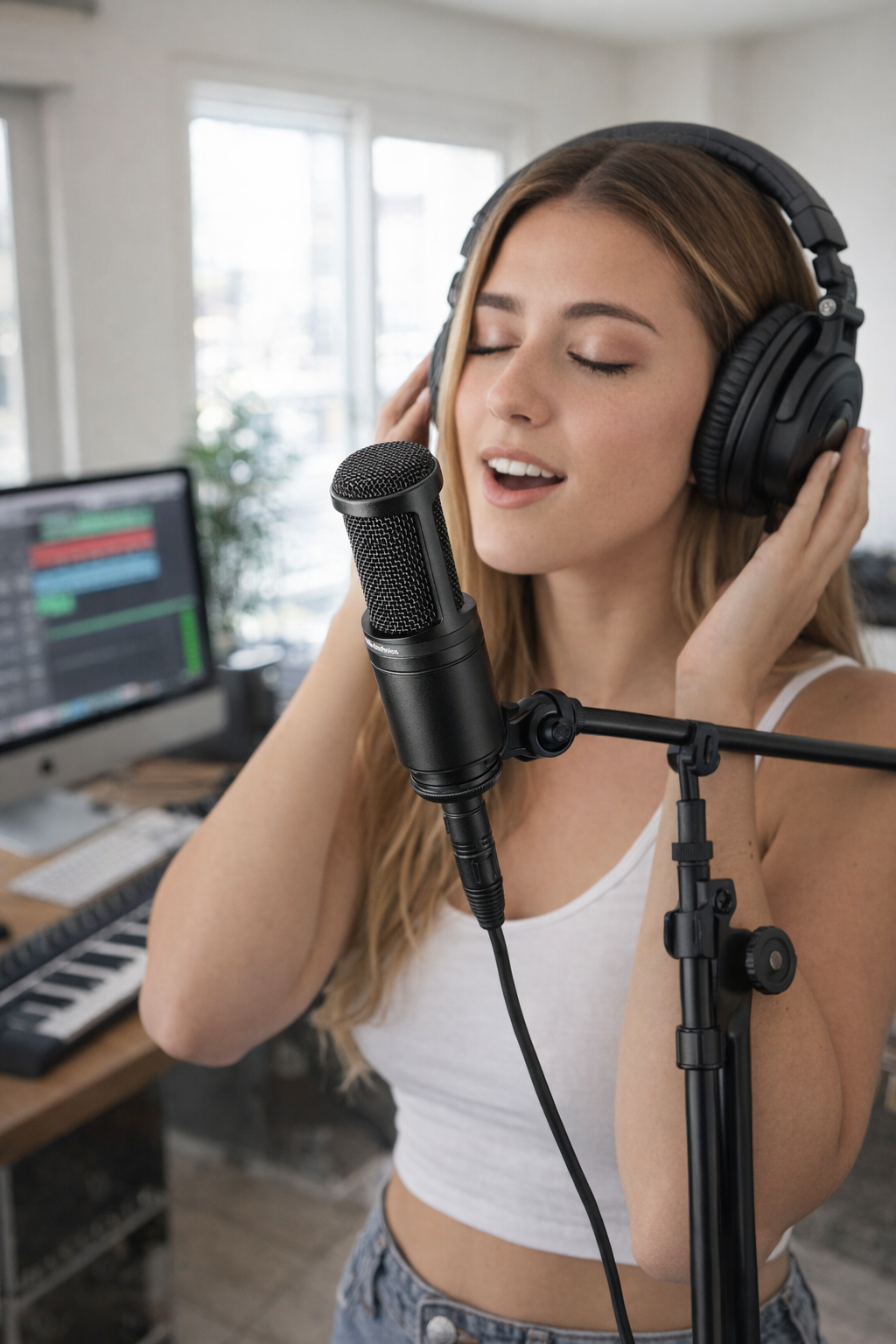
If you've ever dipped a toe into the home studio world, chances are you've come across the Audio-Technica AT2020 Condenser Microphone - usually recommended with the same casual confidence as 'just get a decent pair of headphones and you're good.' There's a reason for that. This mic has quietly become one of the most recognizable entry points into recording, podcasting, and streaming, and it didn't get there by accident.
To understand why the AT2020 shows up everywhere, it helps to look at the company behind it. Audio-Technica was founded in 1962 in Tokyo, originally focusing on high-quality phono cartridges. Over the decades, they expanded into headphones, turntables, and microphones, building a reputation for delivering solid engineering at accessible price points. The AT2020, introduced in the mid-2000s, was part of a deliberate push to bring condenser microphone performance to a much wider audience without the traditional price barrier. And that's really the story here - the AT2020 democratized condenser microphones. Before this era, condenser mics were often seen as 'serious studio gear,' both fragile and expensive. Audio-Technica took that perception and chipped away at it, creating a microphone that could sit comfortably in a bedroom studio next to a laptop and still produce results that felt, well, legit.
From a technical standpoint, the AT2020 is a cardioid condenser microphone, meaning it primarily captures sound from the front while rejecting noise from the sides and rear. This makes it ideal for podcasters and streamers who are working in less-than-perfect acoustic environments. It helps reduce room noise, keyboard clicks, and that neighbor who seems to mow their lawn every time you hit record.
Let's talk specs, because they do matter here. The AT2020 features a fixed charge back plate condenser design, a frequency response of 20 Hz to 20 kHz, and a maximum SPL handling of around 144 dB. Translation - it can handle everything from quiet voiceovers to louder vocal performances without distorting. It also has a relatively low self-noise for its class, which is a big deal when you're recording spoken word content where clarity is everything. One important detail that catches beginners off guard - this mic requires 48V phantom power. That means you'll need an audio interface or mixer that can supply it. Plugging it directly into your computer won't work unless you're using the USB variant, which is a separate model. For anyone building a proper home studio setup, though, this is actually a good thing. It nudges you into a more scalable signal chain early on.
So why do streamers and podcasters keep coming back to the AT2020? In a word - consistency. It delivers a clean, neutral sound that doesn't overly color your voice. That neutrality is useful when you're speaking for long periods, because it avoids listener fatigue. It's forgiving enough for beginners but still respectable enough that you won't feel the urge to upgrade immediately after your first few episodes.
There's also a cultural factor at play. Artists like Billie Eilish have been associated with using relatively accessible recording gear in early stages of their careers, including Audio-Technica microphones. While the AT2020 itself isn't the defining sound of a chart-topping record, its presence in the broader ecosystem reinforces the idea that you don't need a five-figure studio to start creating something meaningful.
Of course, no microphone is perfect, and the AT2020 has its trade-offs. On the pro side, it's affordable, durable, and delivers clear audio that punches above its weight. It's also widely available, meaning replacement parts, mounts, and accessories are easy to find. For someone launching a podcast or starting a Twitch channel, that reliability is a big win. On the downside, it can sound a bit bright on certain voices, especially if you already have a naturally sharp tone. It also doesn't have the warmth or depth that higher-end condenser or dynamic microphones can provide. And for serious voice artists - particularly those doing commercial VO work - the AT2020 may feel a bit limiting in terms of nuance and character.
Another consideration is room treatment. Because it's a condenser mic, it's more sensitive than a typical dynamic microphone. That means it will pick up more of your room's acoustics. If you're recording in a space with hard surfaces and no treatment, you might hear more echo or reflections than you'd like. A few acoustic panels or even some strategic furniture placement can make a noticeable difference.
Still, when you step back and look at the full picture, the AT2020 occupies a very specific and very useful niche. It's not trying to be a boutique studio microphone. It's trying to be the microphone that gets you started, keeps you going, and makes you sound good enough that your content carries the day.
And that brings us to the budget question. If you're considering your first microphone purchase, the AT2020 represents a smart allocation of funds. It leaves room in your budget for an interface, a boom arm, and maybe even some basic acoustic treatment. Instead of blowing everything on a single piece of gear, you're building a balanced setup.
In practical terms, that's often the difference between a hobby that stalls out and one that grows. The AT2020 won't do the work for you, but it will stay out of your way while you figure things out. And in the early stages of podcasting or streaming, that's exactly what you want - a tool that supports your voice without becoming the story.
If you're aiming for Hollywood-grade voiceover work, you'll eventually outgrow it. But if your goal is to start creating, build consistency, and sound professional without overthinking every technical detail, the AT2020 is still one of the most sensible entry points on the market. For a budget mic purchase, that's about as strong an endorsement as it gets.
To understand why the AT2020 shows up everywhere, it helps to look at the company behind it. Audio-Technica was founded in 1962 in Tokyo, originally focusing on high-quality phono cartridges. Over the decades, they expanded into headphones, turntables, and microphones, building a reputation for delivering solid engineering at accessible price points. The AT2020, introduced in the mid-2000s, was part of a deliberate push to bring condenser microphone performance to a much wider audience without the traditional price barrier. And that's really the story here - the AT2020 democratized condenser microphones. Before this era, condenser mics were often seen as 'serious studio gear,' both fragile and expensive. Audio-Technica took that perception and chipped away at it, creating a microphone that could sit comfortably in a bedroom studio next to a laptop and still produce results that felt, well, legit.
From a technical standpoint, the AT2020 is a cardioid condenser microphone, meaning it primarily captures sound from the front while rejecting noise from the sides and rear. This makes it ideal for podcasters and streamers who are working in less-than-perfect acoustic environments. It helps reduce room noise, keyboard clicks, and that neighbor who seems to mow their lawn every time you hit record.
Let's talk specs, because they do matter here. The AT2020 features a fixed charge back plate condenser design, a frequency response of 20 Hz to 20 kHz, and a maximum SPL handling of around 144 dB. Translation - it can handle everything from quiet voiceovers to louder vocal performances without distorting. It also has a relatively low self-noise for its class, which is a big deal when you're recording spoken word content where clarity is everything. One important detail that catches beginners off guard - this mic requires 48V phantom power. That means you'll need an audio interface or mixer that can supply it. Plugging it directly into your computer won't work unless you're using the USB variant, which is a separate model. For anyone building a proper home studio setup, though, this is actually a good thing. It nudges you into a more scalable signal chain early on.
So why do streamers and podcasters keep coming back to the AT2020? In a word - consistency. It delivers a clean, neutral sound that doesn't overly color your voice. That neutrality is useful when you're speaking for long periods, because it avoids listener fatigue. It's forgiving enough for beginners but still respectable enough that you won't feel the urge to upgrade immediately after your first few episodes.
There's also a cultural factor at play. Artists like Billie Eilish have been associated with using relatively accessible recording gear in early stages of their careers, including Audio-Technica microphones. While the AT2020 itself isn't the defining sound of a chart-topping record, its presence in the broader ecosystem reinforces the idea that you don't need a five-figure studio to start creating something meaningful.
Of course, no microphone is perfect, and the AT2020 has its trade-offs. On the pro side, it's affordable, durable, and delivers clear audio that punches above its weight. It's also widely available, meaning replacement parts, mounts, and accessories are easy to find. For someone launching a podcast or starting a Twitch channel, that reliability is a big win. On the downside, it can sound a bit bright on certain voices, especially if you already have a naturally sharp tone. It also doesn't have the warmth or depth that higher-end condenser or dynamic microphones can provide. And for serious voice artists - particularly those doing commercial VO work - the AT2020 may feel a bit limiting in terms of nuance and character.
Another consideration is room treatment. Because it's a condenser mic, it's more sensitive than a typical dynamic microphone. That means it will pick up more of your room's acoustics. If you're recording in a space with hard surfaces and no treatment, you might hear more echo or reflections than you'd like. A few acoustic panels or even some strategic furniture placement can make a noticeable difference.
Still, when you step back and look at the full picture, the AT2020 occupies a very specific and very useful niche. It's not trying to be a boutique studio microphone. It's trying to be the microphone that gets you started, keeps you going, and makes you sound good enough that your content carries the day.
And that brings us to the budget question. If you're considering your first microphone purchase, the AT2020 represents a smart allocation of funds. It leaves room in your budget for an interface, a boom arm, and maybe even some basic acoustic treatment. Instead of blowing everything on a single piece of gear, you're building a balanced setup.
In practical terms, that's often the difference between a hobby that stalls out and one that grows. The AT2020 won't do the work for you, but it will stay out of your way while you figure things out. And in the early stages of podcasting or streaming, that's exactly what you want - a tool that supports your voice without becoming the story.
If you're aiming for Hollywood-grade voiceover work, you'll eventually outgrow it. But if your goal is to start creating, build consistency, and sound professional without overthinking every technical detail, the AT2020 is still one of the most sensible entry points on the market. For a budget mic purchase, that's about as strong an endorsement as it gets.
You may purchase items mentioned in this article here. Affiliate links earn me a commission at no extra cost to you. Thanks for supporting IanGardner.com