AKG C414 Review
The AKG C414 XLII has powered vocals, instruments and professional recordings for decades. Here's why musicians, producers and recording artists keep reaching for this legendary studio microphone.
Ian Gardner is a British-American broadcaster, voice artist and audio enthusiast, sharing years of experience building creative workflows from a modern home studio. He helps readers make smarter buying decisions across studio gear, production tools and home comforts for both inside and outside the workspace. Broadcasters, podcasters, voice artists, producers and digital creators will find guidance that supports high production values and efficient workflows for building a successful home studio business. Similar articles can be found in the microphones blog.
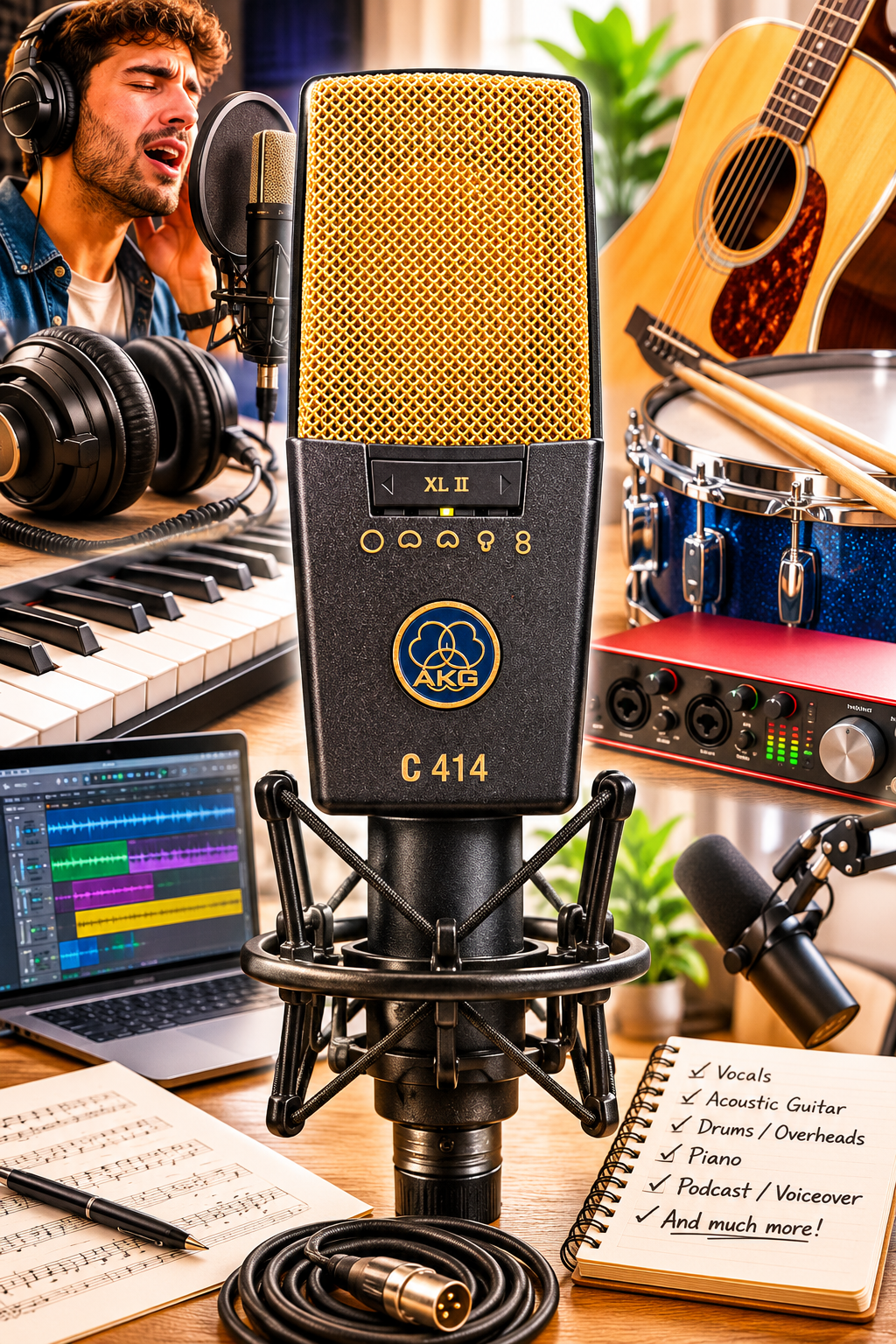
The AKG Pro Audio C414 XLII is the kind of microphone that makes home studio musicians suddenly start talking like seasoned recording engineers. One good vocal take through this thing and you are casually using phrases like 'airy top end' and 'presence boost' while pretending you knew exactly what they meant all along. The C414 XLII has become one of the most respected studio microphones around, and not by accident. It combines serious recording heritage with the kind of flexibility that makes perfect sense in a home studio where one microphone often has to do absolutely everything.
AKG's story begins in Vienna, Austria, where the company was founded in 1947 and quickly established itself as a major force in microphones and studio technology. One of its most legendary creations was the AKG C12, a valve condenser microphone introduced during the 1950s that became famous for its smooth detail, open sound, and luxurious high end character. Engineers loved it, singers loved it, and collectors still love it enough to spend alarming amounts of money tracking one down. The C12 became a benchmark microphone, and its influence still hangs over modern recording gear.
That legacy carried directly into the first AKG C414, launched in 1971. The original C414 retained much of the beloved sonic character of the valve C12 while moving toward a solid-state design that was more practical for everyday studio work. It offered versatility, reliability, and professional sound without requiring the maintenance quirks that came with vintage valve microphones. Over the decades the C414 evolved into multiple versions, but the DNA of that classic design never really disappeared.
The modern AKG Pro Audio C414 XLII proudly leans into those classic roots while packing in features that make home studio owners quietly nod in approval. This is a large diaphragm condenser microphone with nine selectable polar patterns, which means it can adapt to an impressive variety of recording situations. You get cardioid, omni, figure-8, and several options in between, giving you more control than most people realistically expected when they first opened a DAW in a spare bedroom. It is the sort of microphone that can make experimentation feel surprisingly professional.
The specifications stay informative without turning into a full engineering textbook. The C414 XLII covers a frequency response from 20 Hz to 20 kHz, handles high sound pressure levels with ease, and maintains impressively low self-noise. It also includes three attenuation pads at -6 dB, -12 dB, and -18 dB, along with three bass cut filters to help manage everything from booming rooms to loud instruments. In practical home studio terms, this means the microphone is ready for delicate vocals, acoustic guitar, drums, brass, loud amplifiers, and the occasional musical experiment that seemed like a brilliant idea at midnight.
One of the biggest reasons musicians gravitate toward the C414 XLII is its sound signature. The XLII version is known for its gentle upper frequency presence boost, giving recordings a polished sense of clarity and brightness that works especially well on vocals. Singers often find that recordings immediately sound more open, more detailed, and a little closer to that finished commercial sound people chase in modern productions. That does not mean it magically fixes weak performances, questionable room acoustics, or the neighbour's lawn mower, but it can absolutely help a strong recording chain shine.
Home studio musicians particularly benefit from how adaptable this microphone is. In many setups, buying gear involves making one piece of equipment cover several jobs at once. One day the microphone is capturing lead vocals, the next day it is recording acoustic guitar, piano, percussion, drum overheads, or spoken word content. The C414 XLII handles those role changes with impressive confidence, making it a realistic long term investment for musicians who need versatility as much as sound quality.
Recording artists continue to use the C414 family because it delivers detail, flexibility, and dependable studio performance across an enormous range of genres and recording situations. The microphone has appeared in countless professional environments and remains a trusted choice for engineers and performers alike. If you are curious about how widely the AKG C414 has been embraced by famous musicians, check out my blog that explores notable music artists who have used it in their recordings. It is one of those microphones that quietly shows up in more sessions than many people realise.
For home studio owners considering an upgrade, the AKG Pro Audio C414 XLII occupies a very appealing space. It carries decades of recording heritage, traces its ancestry back through the influential 1971 C414 and iconic C12 lineage, and offers enough flexibility to tackle a huge range of recording tasks. It feels equally at home in professional environments and carefully assembled bedroom studios. If your microphone wishlist includes versatility, musical detail, classic pedigree, and a strong possibility of saying 'just one more take' far too many times, the C414 XLII deserves a very serious look.
AKG's story begins in Vienna, Austria, where the company was founded in 1947 and quickly established itself as a major force in microphones and studio technology. One of its most legendary creations was the AKG C12, a valve condenser microphone introduced during the 1950s that became famous for its smooth detail, open sound, and luxurious high end character. Engineers loved it, singers loved it, and collectors still love it enough to spend alarming amounts of money tracking one down. The C12 became a benchmark microphone, and its influence still hangs over modern recording gear.
That legacy carried directly into the first AKG C414, launched in 1971. The original C414 retained much of the beloved sonic character of the valve C12 while moving toward a solid-state design that was more practical for everyday studio work. It offered versatility, reliability, and professional sound without requiring the maintenance quirks that came with vintage valve microphones. Over the decades the C414 evolved into multiple versions, but the DNA of that classic design never really disappeared.
The modern AKG Pro Audio C414 XLII proudly leans into those classic roots while packing in features that make home studio owners quietly nod in approval. This is a large diaphragm condenser microphone with nine selectable polar patterns, which means it can adapt to an impressive variety of recording situations. You get cardioid, omni, figure-8, and several options in between, giving you more control than most people realistically expected when they first opened a DAW in a spare bedroom. It is the sort of microphone that can make experimentation feel surprisingly professional.
The specifications stay informative without turning into a full engineering textbook. The C414 XLII covers a frequency response from 20 Hz to 20 kHz, handles high sound pressure levels with ease, and maintains impressively low self-noise. It also includes three attenuation pads at -6 dB, -12 dB, and -18 dB, along with three bass cut filters to help manage everything from booming rooms to loud instruments. In practical home studio terms, this means the microphone is ready for delicate vocals, acoustic guitar, drums, brass, loud amplifiers, and the occasional musical experiment that seemed like a brilliant idea at midnight.
One of the biggest reasons musicians gravitate toward the C414 XLII is its sound signature. The XLII version is known for its gentle upper frequency presence boost, giving recordings a polished sense of clarity and brightness that works especially well on vocals. Singers often find that recordings immediately sound more open, more detailed, and a little closer to that finished commercial sound people chase in modern productions. That does not mean it magically fixes weak performances, questionable room acoustics, or the neighbour's lawn mower, but it can absolutely help a strong recording chain shine.
Home studio musicians particularly benefit from how adaptable this microphone is. In many setups, buying gear involves making one piece of equipment cover several jobs at once. One day the microphone is capturing lead vocals, the next day it is recording acoustic guitar, piano, percussion, drum overheads, or spoken word content. The C414 XLII handles those role changes with impressive confidence, making it a realistic long term investment for musicians who need versatility as much as sound quality.
Recording artists continue to use the C414 family because it delivers detail, flexibility, and dependable studio performance across an enormous range of genres and recording situations. The microphone has appeared in countless professional environments and remains a trusted choice for engineers and performers alike. If you are curious about how widely the AKG C414 has been embraced by famous musicians, check out my blog that explores notable music artists who have used it in their recordings. It is one of those microphones that quietly shows up in more sessions than many people realise.
For home studio owners considering an upgrade, the AKG Pro Audio C414 XLII occupies a very appealing space. It carries decades of recording heritage, traces its ancestry back through the influential 1971 C414 and iconic C12 lineage, and offers enough flexibility to tackle a huge range of recording tasks. It feels equally at home in professional environments and carefully assembled bedroom studios. If your microphone wishlist includes versatility, musical detail, classic pedigree, and a strong possibility of saying 'just one more take' far too many times, the C414 XLII deserves a very serious look.
You may purchase items mentioned in this article here. Affiliate links earn me a commission at no extra cost to you. Thanks for supporting IanGardner.com